Artificial intelligence (AI) is becoming less of a speculative frontier and more of a tangible — if still unevenly distributed — presence in philanthropy. In a 2025 survey of 215 foundation leaders, the Center for Effective Philanthropy found that 81% of foundations reported some degree of AI usage, but only 4% said AI was being used systematically across the organization (Smith Arrillaga, Grundhoefer, & Im, 2025).
The sector’s use of AI so far has been less of a monolithic transformation and more of an evolving mosaic of different mindsets, use cases, and degrees of institutional readiness. Most foundations are approaching AI cautiously, recognizing that its risks range from privacy concerns to organizational misalignment and the unintentional reinforcement of inequities. The sector is collectively asking: How do we harness AI’s potential without betraying philanthropy’s human-centered values?
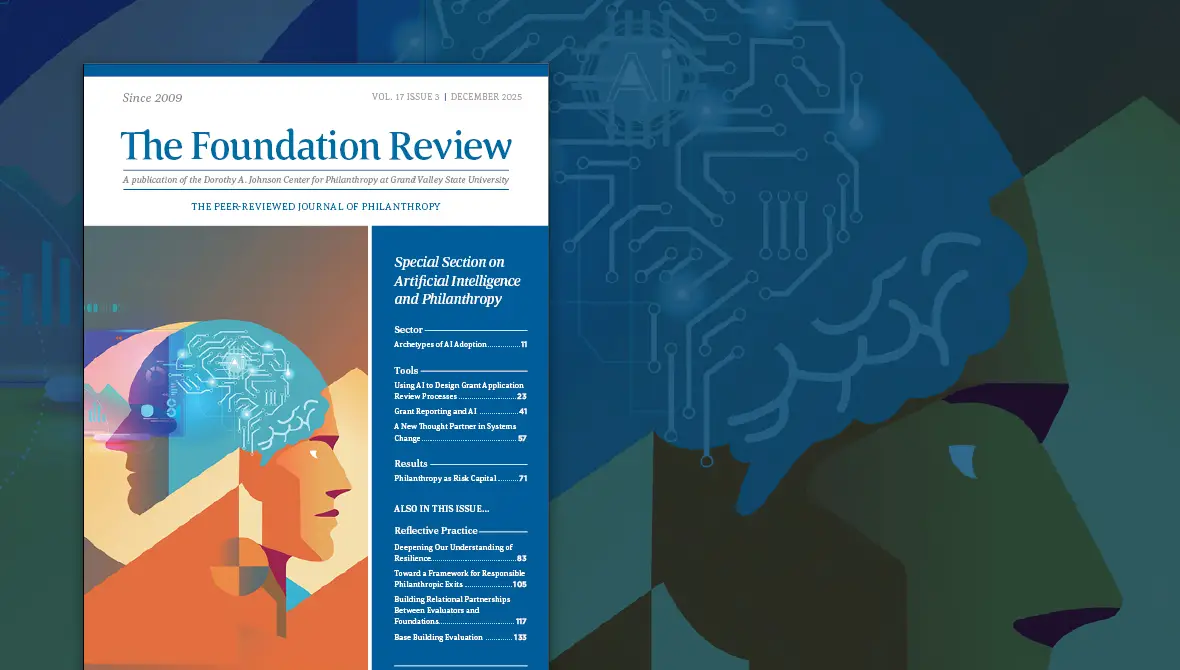
This open-access issue features five articles on the use of AI in philanthropy. Each highlights leaders who have forged ahead while acknowledging the risks, deploying AI for different purposes, and then thoughtfully reflecting on their experiences.
Given the pace of technological development, as soon as this AI issue is published, the sector will have already moved on to new experiments and lessons. Philanthropy’s early experiences with AI are important, however, because they serve as laboratories for understanding how emerging technologies interact with values, power, and purpose in mission-driven work. Unlike the private sector, where AI adoption is driven primarily by efficiency or profit, philanthropy’s experiments offer insights into how AI can (or cannot) serve the public good.
This issue also includes four bonus articles that explore other issues that, like AI adoption, represent complex challenges in a constantly changing sector. Enjoy!


Julia Coffman
Editor-in-Chief
The Foundation Review
Special thanks to the California Health Care Foundation and Porticus for their sponsorship of this issue.
Are you interested in partnering with us on an upcoming issue of The Foundation Review? Let’s connect!
The emergence of generative AI technologies catalyzed an unprecedented wave of philanthropic experimentation and investment. This article presents a “snapshot in time” of the sector’s AI uptake and use, explores current policy and practice, and identifies gaps requiring research or collective action. Authors identify patterns in AI adoption and grantmaking and surface the sector’s concerns about its implementation.
Grant applications play a critical role in how grant recipients are selected. While many funders are eager for more streamlined and equitable approaches, the process primarily remains a time-consuming and manual one. This article describes how Missouri Foundation for Health and AI PRIORI® used AI to explore a more effective, efficient, and equitable application review process.
Instead of being a learning tool, grant reporting can be a bureaucratic exercise that creates burden and reinforces power asymmetries. As philanthropy confronts demands for more equity and transparency, reporting must transform into a more productive space for collective sensemaking. This article explores how AI paired with Oral and Alternate Reporting (OAR) methods can build more human-centered reporting.
With efforts aimed at systemic change, we often struggle to find impactful moments or opportunities for shifting systems. AI can be a new type of systems change “contributor,” offering deep knowledge and rapid synthesis about both systems and contexts. This article explores examples of how to use AI to develop, test, evaluate, or refine philanthropic systems change strategies.
This article draws on three sources of learning at Omidyar Network to identify how philanthropy can uniquely “de-risk” AI innovation for collective benefit. It offers four insights for how foundations can use learning to unlock collaboration, shift public narratives, and equip the field to act with both urgency and wisdom when shaping AI’s trajectory.
This article offers an overarching framework of four different responses to system shocks and disruptions that lead to four different evaluation criteria: continuity, adaptation, innovation, and capitulation. Considering new directions for philanthropic evaluation, it suggests elevating adaptive resilience as a core capacity and evaluation criterion for grantees and foundations generally.
When foundations decide to cease funding in a specific area, how they exit can significantly impact the field they are leaving. Authors at three philanthropies define what a responsible philanthropic exit entails based on literature, focus groups, interviews, and their own experiences. The resulting framework outlines seven elements to ensure an ecosystem is equipped to continue the work when funders step away.
This article explores a collaborative and emergent effort between evaluation consultants and foundations to redesign procurement and contracting processes. Through a year of facilitated reflection, the mindsets, myths, and tensions embedded in existing practices were surfaced. This article offers insights and principles that invite more equitable and relational approaches to collaboration.
Guidance about how to appropriately assess the progress and impact of base building efforts is lacking. This article provides community change funders and evaluators with insights about the unique characteristics of base building and their implications for assessment. Authors provides specific ideas for evaluation approaches and practices that are aligned with and can support effective base building practice.