FIELD FOCUS
Redefining Community Philanthropy
A limited series on generosity, belonging, and what it means to give

In this Field Focus: Redefining Community Philanthropy series, we dig into the words themselves — what community really means, what philanthropy was always meant to mean, and what an expanded definition could make possible for a field ready to evolve.

Over the next three months, we’ll bring together researchers, practitioners, and movement leaders from around the world who have been doing the work for years — democratizing who gets to be called a philanthropist, honoring the full spectrum of generosity, and, perhaps most importantly, recentering love as the root of this conversation.

BLOG

More Than a Neighborhood: The Many Meanings of “Community”

What do we mean when we talk about community? The word is used with great frequency, and its meaning is often assumed rather than examined. In this opening essay of this Field Focus series, Dr. Layton explores the contours of community as a concept and an empirical phenomenon — one that can be a source of support and healing, but can also divide and exclude.

Read More

Illustration of dozens of hands in different sizes and colors reaching toward one another, representing community

BLOG

Defining “Philanthropy,” Part I: Love of Humankind

Somewhere along the way, philanthropy, a word that once meant the love of humankind, became a synonym for a very particular kind of transaction — the powerful dispensing money to the less fortunate. Too often overlooked are the everyday givers, the mutual aid networks, the neighbors who show up, the care workers, and the giving circles that sustain communities. Dr. Layton examines how the definition of “philanthropy” has narrowed over time and makes the case that the fuller meaning remains available to us — if we are willing to fight for it.

Read Part I

BLOG

Defining “Philanthropy,” Part II: Reclaiming What Philanthropy Was Always Meant to Be

What if we could reclaim the true definition of philanthropy by looking at how people actually give — not through the lens of foundations and endowments, but through the evidence of everyday practice? That evidence reveals a story not of decline but of reclamation: a growing body of scholarship and practice that is, quietly and sometimes not so quietly, bringing the love back to philanthropy.

Read Part II


Catalysts of Community Philanthropy: How Community Foundations, Collective Giving, and Giving Days Strengthen Civic Life (June 23, 2026)

Free Webinar: June 23

Drawing on recently published research, the Catalysts of Community Philanthropy webinar will introduce a shared vocabulary for understanding community philanthropy. A panel of field experts will discuss how community foundations, giving circles, mutual aid groups, giving days, and neighborhood-led funds are expanding participation, strengthening trust, and shifting power to communities. Join us!

Learn More & Register

THE FOUNDATION REVIEW

Defining Community Philanthropy

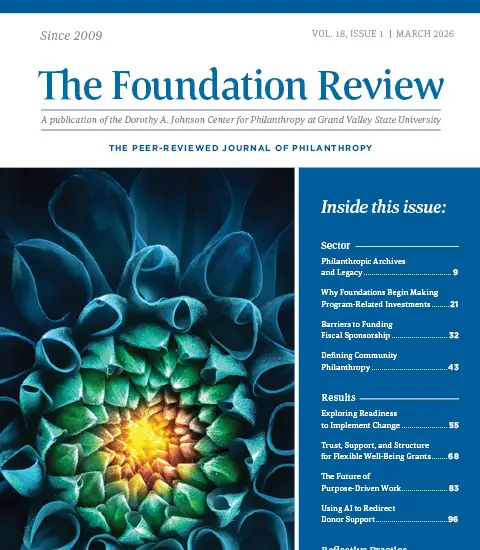
Community philanthropy is increasingly promoted as an alternative to institutional, top-down philanthropy, yet the term remains contested. In this article from The Foundation Review, Vol. 18, Issue 1, Dr. Layton defines community philanthropy as a practice rooted in context, power, and relationships rather than a single institutional form. This reframing is significant in a field that tends to emphasize organizational form over lived practice. The article identifies five characteristics that distinguish community philanthropy and offers ways to assess it without flattening its diversity. 
Since the creation of the first community foundation in 1914, community philanthropy has expanded conceptually and geographically. It is now one of the most important global movements to expand and elevate generosity, driven by the core belief that communities are uniquely positioned to mobilize their own assets to address their own challenges.”
Michael D. Layton, Ph.D.
W.K. Kellogg Chair for Community Philanthropy
Leading the Center’s Work on Community Philanthropy
As the W.K. Kellogg Community Philanthropy Chair, Michael Layton brings to the position decades of experience in the practice and study of philanthropy. He has served as a professor, researcher, director, and consultant at some of the world’s most prominent universities, philanthropies, and development agencies.
Visit Bio

Alliance Magazine

Reweaving the Social Fabric Amid Latin America’s Fragile Institutions

Latin America is navigating a convergence of deep mistrust, extreme inequality, and chronic institutional fragility. This loss of confidence extends into daily life and is reflected in low interpersonal trust, polarisation, and mounting democratic fatigue across the region. Yet within this difficult landscape, community foundations are helping to redefine legitimacy and trust. In this special feature, Dr. Layton and co-authors explore post-institutional civic infrastructure, highlight adaptive models in action, and present a forecast for the future in which the strength of Latin American community foundations relies not on replicating models inherited from the Global North but in evolving on their own terms.