
In 2023, my colleague and friend Dana Doan published an essay in HistPhil that asked: Where is the love? (Doan, 2023). It was precisely the right question to ask, and one that I have not been able to stop thinking about.
At least since the time of Carnegie and Rockefeller — who built the first modern philanthropic foundations, and with them, the template for what philanthropy is supposed to look like — the word “philanthropy” has become singularly identified with the largesse of the wealthy. Specifically, it’s an act of noblesse oblige measured in donations, endowments, and gifts of six figures (or, preferably, many more).
Somewhere along the way, a word that once meant the love of humankind became a synonym for a very particular kind of transaction — the powerful dispensing money downward to the less fortunate. The everyday givers, the mutual aid networks, the neighbors who show up, the care workers, the giving circles; these barely register in that picture at all.
“[A] word that once meant the love of humankind became a synonym for a very particular kind of transaction — the powerful dispensing money downward to the less fortunate.”
Doan was working in community philanthropy in Vietnam and the U.S. when she asked her question. She was asking it from both sides of the world, having found that the same narrowing of this word’s practical definition applied in both places. That universality is itself telling.
Doan’s response to this narrowing is worth quoting directly. Rather than abandon the word, she argues for restoring it. “I propose that we bring back the love,” she writes. She calls for bringing the philos back to philanthropy, paying more attention to everyday givers and ensuring that the expressive, relational roles of giving are represented in how we define and measure the concept (Doan, 2023).[1] This essay is inspired by the same conviction.
I also firmly believe that the word philanthropy is worth reclaiming. Its etymology carries an implicit argument: an argument about love, about shared humanity, about how generosity is not always — or even most often — expressed in dollars. It also holds an argument about what we lose when the love in philanthropy disappears.
This essay does not offer a new definition of philanthropy. That work is taken up in an article on community philanthropy (in Vol. 18, Issue 1, of The Foundation Review), toward which these reflections are building. What this essay attempts is something equally necessary: to trace how the word came to mean what it does now, to recover what was lost in that narrowing, and to make the case that the fuller meaning is still available to us, if we are willing to fight for it.
Sulek has produced two thorough philosophical and etymological accounts of philanthrôpía (2009a, 2009b). Additionally, Vallely’s (2020) sweeping historical survey traces philanthropy from Aristotle to Zuckerberg across 750 pages — a work whose breadth makes plain how long this conversation has been going on, even as its focus remains largely on philanthropy as the donation of money, primarily by the wealthy. This essay draws on that scholarship but argues for something those three accounts do not quite provide: a recovery of what was always there alongside the grand gestures, and a case for why naming it matters.
The word philanthrôpía is a compound word in ancient Greek, with its roots in phileô, the love that occurs between friends, and anthrôpos, humankind (Sulek, 2009b). Most scholars agree that the word makes its first appearance in Aeschylus’s play Prometheus Bound, where the playwright describes Prometheus’s gift of fire to humanity as an act of philanthrôpía. By the late fourth century BCE, the term had broadened still further, describing everyday sociability, hospitality, and kindness. Philanthrôpía was, at its most expansive, a way of being in the world with other people (Sulek, 2009b).
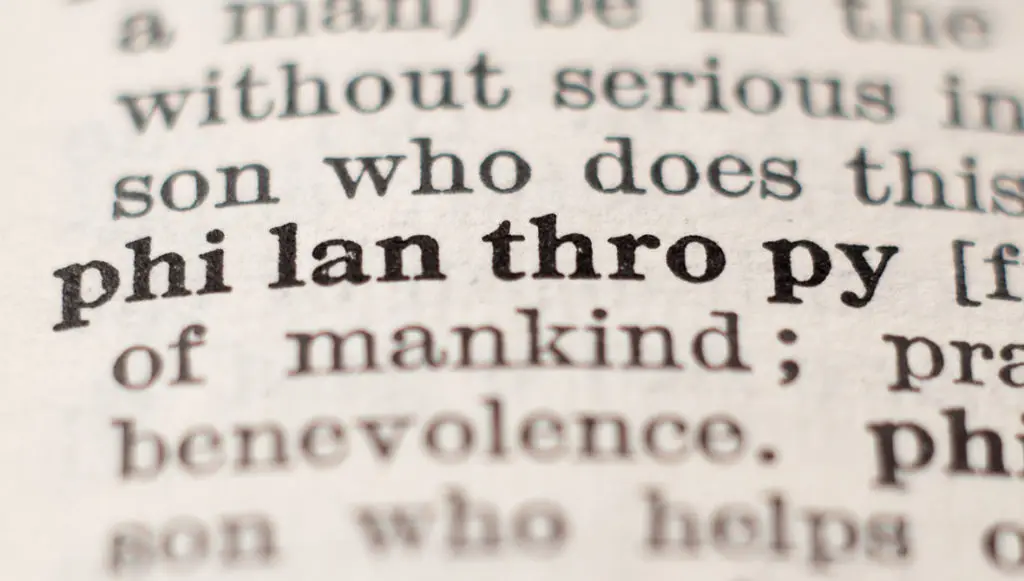
In the modern era, the application of the word has narrowed. Early modern thinkers like Francis Bacon associated philanthrôpía with goodness and the desire to promote the common welfare, and Samuel Johnson’s dictionary defined it as “love of mankind; good nature; desire to do good” (Sulek, 2009a) — a definition that preserved the word’s original breadth. But over time, something shifted. The Oxford English Dictionary’s (n.d.) current entry still opens with “love of humankind,” but adds, “now especially expressed by the generous donation of money to good causes.” That phrase, “now especially,” is the sound of a concept being quietly amended.
It is worth pausing here to note that other languages have preserved something closer to the original spirit. In Vietnamese, Doan (2023) observes, the closest equivalents to philanthropy — từ thiện and thiện nguyện — both foreground the personal values of love, goodness, and goodwill. These resonate directly with the word’s Greek origins in ways that the English term, in its contemporary usage, no longer does. That preservation matters. It suggests the narrowing was not inevitable — that the original meaning survived in other traditions and can be recovered in ours.
The evidence that this narrowing has stuck is not hard to find. Beth Breeze (2021) points to John Howard, the first British person to earn the label of philanthropist. Howard gained renown in the late eighteenth century for helping debtors and prisoners, dedicating his life to prison reform without providing any financial assistance. Today, Breeze observes, Howard would simply be called an activist, because “the word ‘philanthropy’ has become synonymous with donating large sums of money” (p. 23). When she surveyed a representative sample of the British public and asked them to define “philanthropist” in three words, three of the 10 most popular responses were wealthy, rich, and money (Breeze, 2021, p. 23). The non-wealthy, she notes, are considered donors, not philanthropists.
This linguistic drift has institutional consequences. For example, Giving USA (n.d.), the longest-running annual report on charitable giving in the U.S., measures philanthropy almost entirely as dollars donated to registered nonprofit organizations, and its data infrastructure is built around monetary transactions.
Others have responded by adopting other terms. The Generosity Commission’s (2024) final report is titled Everyday Actions, Extraordinary Potential: The Power of Giving and Volunteering — preferring generosity as its organizing concept, broad enough to encompass mutual aid, informal giving, and care work that standard measures miss entirely. GivingTuesday’s (2025) strategic plan defines generosity as “an expression of reciprocity, mutuality, and solidarity as well as faith in community and care for family, neighbors, and strangers alike,” a definition that sounds unmistakably like the original philanthrôpía.
These differences are not merely semantic. They reflect a genuine contest over what counts, who counts, and what the purpose of giving actually is — a contest this essay enters on the side of reclamation. The word philanthropy carries a history worth recovering, and an argument worth making. But to make it fully, we need to understand how the narrowing happened.
The narrowing that the Oxford English Dictionary quietly registered in its definition did not happen by accident. It happened because of specific people, specific institutions, and a specific historical moment — one that permanently reshaped how Americans, and much of the world, understood what philanthropy was and who counted as a philanthropist.
“[S]pecific people, specific institutions, and a specific historical moment … permanently reshaped how Americans, and much of the world, understood what philanthropy was and who counted as a philanthropist.”
Since before the nation’s founding, Americans had been building the civic infrastructure of a democratic republic through voluntary associations, charitable institutions, and religious benevolence — a tradition of giving that, as McCarthy (2003) and Zunz (2012) have documented, was inseparable from the project of self-governance itself.
By the late nineteenth century, a distinction had emerged in American giving between what scholars came to call “Christian charity,” focused on alleviating the immediate suffering of the poor, and a new approach that styled itself “scientific philanthropy,” aimed instead at addressing the root causes of poverty and social problems (Sulek, 2009a). The Rockefeller philanthropies, under the direction of Frederick Gates, exemplified this new model: disciplined, research-driven, focused on permanent solutions rather than temporary relief.
Andrew Carnegie pursued a parallel vision. His Gospel of Wealth, published in 1889, argued that the concentration of great fortunes in the hands of the capable few was not a social problem but a social resource. The rich could administer that wealth, transformed into philanthropy, “for the community far better than it could or would have done for itself” (p. 23). Carnegie saw clearly that inequality was tearing society apart; his proposed remedy was philanthropy as stewardship, the wealthy serving as “trustees” for the public good (Carnegie, 1889, p. 23). Philanthropy flowed downward, from those who knew best to those who needed most.
What Carnegie and Rockefeller built was not merely a set of institutions, though the foundations they created became enormously influential. In the public imagination, the press, and public policy, their model — wealthy individuals and their foundations dispensing resources to address social problems — became synonymous with what philanthropy meant and what it looked like. To be a philanthropist was to be, in some measure, Carnegie.
As Sulek (2009a) notes, drawing on Salamon’s (1992) widely adopted formulation, philanthropy came to be understood in the modern social sciences as essentially the private giving of funds — and, to a lesser extent, time — for public purposes. In practice, philanthropy was synonymous with charitable donations to nonprofit organizations. The love of humankind had been translated into a financial transaction; a way of being in the world had been shrunk down to a line on a balance sheet.
“The love of humankind had been translated into a financial transaction; a way of being in the world had been shrunk down to a line on a balance sheet.”
What this model overshadowed was not a marginal or exceptional practice but a living and longstanding tradition of giving that had always been the primary form of philanthropic life. During the same decades that Carnegie and Rockefeller were reshaping American giving, Jane Addams, W.E.B. Du Bois, and Madam C. J. Walker each practiced and embodied a fundamentally different vision of what philanthropy — and philanthropists — could look like.
In Twenty Years at Hull-House (1910), Addams wrote that Hull-House was “soberly opened on the theory that the dependence of classes on each other is reciprocal” (p. 91), a founding commitment to solidarity rather than stewardship, to shared life rather than charitable dispensation. In The Philadelphia Negro (1899), Du Bois mapped the churches, mutual aid societies, fraternal orders, and cooperative associations that Black Philadelphians had built together. He saw in them something Carnegie’s philanthropy could not produce: communities strengthening themselves from within. It was in mastering what Du Bois called “the art of social organized life” that he located their greatest hope (p. 233).
Freeman’s (2020) scholarship on Madam C. J. Walker sharpens the contrast further. Walker’s philanthropy, Freeman argues, did not originate in wealth but in “resourceful efforts to meet social needs” — a “medley of beneficent acts” rooted in a collective consciousness and shared experience of humanity (pp. 3–4). While Carnegie and Rockefeller accumulated fortunes before turning to giving, Walker’s philanthropy was embodied from the beginning: she gave of her time, influence, and modest resources long before she became a millionaire.
Freeman explicitly frames Walker’s “gospel of giving” as a counter-narrative to Carnegie’s “gospel of wealth” — a tradition in which philanthropy was not the prerogative of the rich but the practice of the community. What Walker, Addams, and Du Bois each embodied was not a marginal or lesser form of giving. It was philanthropy in its fullest sense, conducted without the name.
This essay echoes Freeman, Addams, and Du Bois in insisting that what they documented and practiced was philanthropy — not a lesser form of it, not charity by another name, but the genuine article. The narrowing that made Carnegie the archetype and Walker the exception was a historical distortion, not an accurate account of how people actually organized their generosity. Recovering that fuller picture is what this article attempts.
Admittedly, Andrew Carnegie’s model of philanthropy did not simply become dominant in our society — it became definitional. But the practices and legacies of Madam C. J. Walker, Jane Addams, and W.E.B. Du Bois are not singular. Scholars are now recovering similar traditions among many communities whose generosity was organized, sustained, and consequential, yet never labeled as philanthropy.
To cite just two examples: Sylviane Diouf’s (2013) work on enslaved African Muslims in the Americas and Jessica Criales’s (2019) research on Indigenous Christian communities in the U.S. and Mexico both document forms of collective giving and mutual obligation that existed entirely outside the Carnegie model. These histories are still being written, and they matter: they remind us that what went unnamed was not therefore absent.
That broader tradition has never been more visible than it became during the COVID-19 pandemic. Mutual aid — the practice of neighbors helping neighbors, of communities organizing to meet needs that institutions could not or would not reach — surged into public view. As Spade (2020) argues, mutual aid is not charity: it does not reproduce the vertical hierarchies of donor and recipient, but operates instead as a collective practice in which people contribute what they can and receive what they need. This was not a new invention. It was the surfacing of something old. The pandemic revealed what was always there — a vast, living tradition of giving rooted in solidarity rather than surplus, in connection rather than condescension.
This tradition, recovered and named, is what Part II of this series traces into the present.
————————-
[1] Doan’s essay has been a formative influence on my own thinking about the definition of philanthropy. Her call to bring back the love — and her insistence that the word is worth fighting for rather than discarding — shapes the argument I develop here.





© 2026 Dorothy A. Johnson Center for Philanthropy. All rights reserved.
201 Front Ave SW, Suite 200, Grand Rapids, Michigan 49504 | (616) 331-7585 | jcp@gvsu.edu