

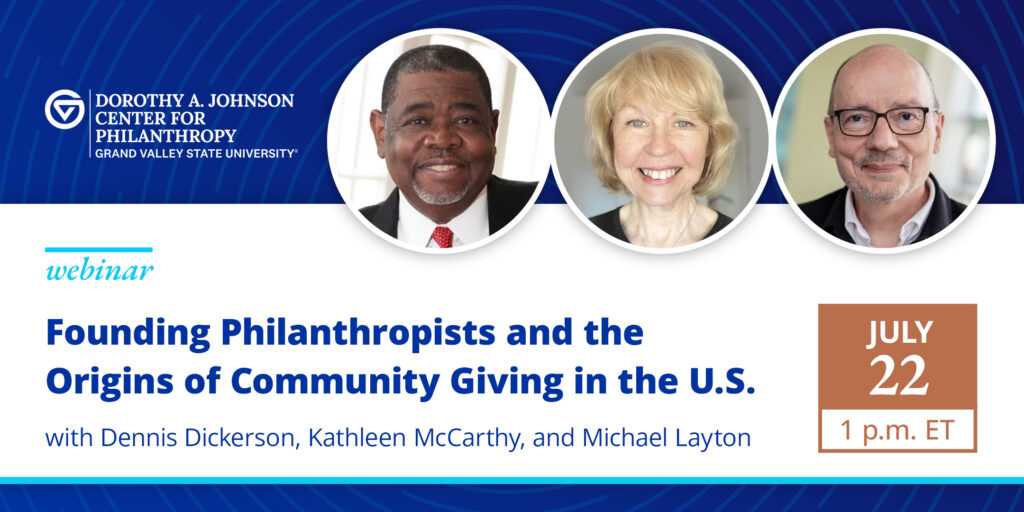
A webinar exploring the traditions and trajectory of generosity in America
Long before the modern philanthropic foundation, Americans were forming associations, pooling resources, and creating institutions that gave democratic ideals their practical expression. While the signing of the Declaration of Independence 250 years ago gave American democracy its creed, voluntary association gave it its daily life — what de Tocqueville called its “habits of the heart.”
This webinar takes the lives of three extraordinary Americans as a starting point for exploring this nation’s traditions of community problem-solving and mutual aid. By tracing how their individual philanthropic legacies continue to shape their communities even centuries after their deaths, we open a conversation on the nature of community philanthropy, today’s crisis of connection, and our potential to come together again.
- Benjamin Franklin built institutions that survive to this day — the Library Company of Philadelphia, the American Philosophical Society, the University of Pennsylvania — and, in doing so, helped establish a distinctly American model of civic problem-solving: voluntary, collaborative, and independent of government.
- Richard Allen, born enslaved and self-emancipated, founded the African Methodist Episcopal Church in Philadelphia in 1794 — the first independent Black denomination in the U.S. His story highlights an enduring tradition: Black Americans building mutual aid networks, literacy programs, and institutions of collective dignity under conditions of profound constraint.
- Rebecca Gratz embraced philanthropic work at age twenty and spent the next six decades founding the nonsectarian Philadelphia Orphan Asylum, the Female Hebrew Benevolent Society, and the first Hebrew Sunday School in the United States. In an era when the formal political system was an exclusively male domain, her story illustrates how civil society offered women an alternative arena in which to organize, build, and lead institutions of lasting consequence.
A panel of field experts will explore their legacies to demonstrate how today’s mutual aid networks, collective giving, grassroots organizing, and philanthropic institutions continue these founding traditions.
Price: Free
Format: Virtual
Panelists
Dr. Dennis C. Dickerson is the Reverend James M. Lawson Chair in History, Emeritus, at Vanderbilt University. His landmark book, The African Methodist Episcopal Church: A History, begins with Bishop Richard Allen’s founding of the AME Church during the republic’s infancy and follows the Black church as an enduring space for civil society, mutual aid, and the struggle for freedom throughout American history.
Dr. Kathleen McCarthy is the founding director of the Center on Philanthropy and Civil Society at the CUNY Graduate Center and Professor of History. Her book, American Creed: Philanthropy and the Rise of Civil Society, 1700–1865, is the foundational historical account of how voluntary association and democratic self-governance developed together in America.
Dr. Michael D. Layton is the W.K. Kellogg Community Philanthropy Chair at the Dorothy A. Johnson Center for Philanthropy. A Philadelphia native, he began his career working in the neighborhood where he was born and raised, founding the New Kensington Community Development Corporation before pursuing advanced study to deepen his understanding of community, philanthropy, and democracy.
Moderator
Tory Martin is the director of engagement and knowledge building at the Dorothy A. Johnson Center for Philanthropy. Before joining the Johnson Center, she was a member of NPR’s institutional fundraising team and served in several roles at the Smithsonian Institution’s National Museum of American History. Tory is a proud graduate of Mr. Jefferson’s University, holding a B.A. in American studies and history from the University of Virginia and an M.A. in American studies from Georgetown University.
Please note: This webinar will be recorded and shared publicly online after the live session.
Questions about this event or your registration?
Call 616-331-7585 or email jcp@gvsu.edu.