America is in a period of profound transition — and not just because of changing federal policies under a new presidential administration. Over the past decade, the nation has experienced heightened political and social upheaval, change, and transition, accompanied by a decline in public trust in institutions. In his essay for the Urban Institute, Jacob Harold reminds us that “institutions are patterns of relationship,” and those relationships are steadily weakening. Whether you look at data from Gallup, Pew, Edelman, or other surveys, multiple researchers are identifying that trust in our systems is at historic lows.
This reality made us curious about what is happening within the nonprofit and philanthropic ecosystem itself. Nonprofits often fill the gaps that remain when other institutions falter — providing food, housing, education, and essential services — and philanthropy helps sustain that work. Building on previous research, we sought to delve further into the extent to which the public trusts these actors and whether that trust is consistent across sectors and sub-sectors.
In April 2023, we saw a report from the Lilly Family School of Philanthropy at Indiana University (Lilly School) titled What Americans Think about Philanthropy and Nonprofits. This study sheds light on the current state of trust between the public and the nonprofit sector — and, more importantly, it explores how Americans understand, perceive, and relate to philanthropy in its various forms. The findings reveal a striking disconnect between the values Americans hold and their understanding of philanthropy. Although 85% of respondents view volunteering, and 84% view donating money as philanthropic activities — and nearly 60% have donated to charity in the past year — only 20% of respondents self-identify as philanthropists.
Roughly a year later, the Center for Public Interest Communications at the University of Florida and the Council on Foundations collaborated on a joint project to build upon those findings. Their goal was to test whether stories, metaphors, or message framing could meaningfully shift public understanding and trust in foundations. Specifically, this project fielded a new national survey to “(1) Investigate how Americans view foundations and philanthropy, repeating some questions from the Lilly School’s survey tool; (2) Experiment with whether different types of stories about foundations may increase people’s trust in foundations and reduce their concerns and (3) Examine how we might use different metaphors about foundations to improve people’s trust in foundations.”
Both surveys included batteries of questions about trust in the nonprofit sector, conducted approximately a year apart. The results created an opportunity to begin comparing changes in public attitudes over time, though each survey had its own focus and methodology. Building on this foundation, our team conducted a third national survey[1] in March 2025, asking some of the same questions as previous surveys to facilitate comparison. We consulted with other experts in the field, including the Michigan Nonprofit Association, the Council of Michigan Foundations, Data Driven Detroit, Detroit Future City, the Leadership Conference Education Fund, and others, during survey construction to determine which questions would be most useful for their work. The survey was designed to be both diagnostic and exploratory — a way to test perceptions of trust in nonprofits and philanthropy during a time of heightened institutional unpredictability, rather than a definitive assessment of the current state of trust.
As we reviewed the results, we recognized that policy developments in Washington, D.C., could meaningfully affect our conclusions. To capture any shifts in public perception following policy changes and growing debates about data privacy, we decided to field a follow-up survey[2] in September 2025. This second wave allowed us to test not only levels of trust but also how people feel about sharing personal information with different types of institutions.
The nonprofit and philanthropic sectors, although interrelated and interdependent, are distinct industries that are far too often treated as monoliths. While both are heavily dependent on trust for their survival, to date, most studies have failed to explore and differentiate between them thoroughly. This lack of differentiation limits our ability to understand where trust is strong and where it is fragile. Specifically, little effort has been devoted to examining the organizations that comprise each category — nonprofits versus philanthropy, foundations versus grassroots groups, and corporate giving versus community-based efforts. Yet the public experiences these actors very differently. A local food bank, a community foundation, and a corporate grantmaker each carry reputational baggage and a different depth of local relationships with the people they serve.
This lack of nuance leaves us with more questions than answers, such as:
“Without clarity on the questions above, it is difficult for organizations to respond meaningfully to public concerns or strengthen community relationships. Moreover, without better data disaggregation — by type of organization, geography, or scale — we risk misinterpreting what drives gains or declines in trust.”
Without clarity on the questions above, it is difficult for organizations to respond meaningfully to public concerns or strengthen community relationships. Moreover, without better data disaggregation — by type of organization, geography, or scale — we risk misinterpreting what drives gains or declines in trust. This is especially critical because nonprofits often step in where government steps back — providing food, housing, education, healthcare, and other essential services that communities depend on. As expectations rise and resources fluctuate, maintaining trust becomes both more challenging and increasingly crucial for the sector’s legitimacy. The Urban Institute reports that one-third of U.S. nonprofit service providers experienced disruptions in government funding in early 2025. These organizations run food pantries, provide tutoring or job training, offer mental health services, and more. The sector’s responsibility for delivering essential public goods positions it at the core of community well-being, where maintaining trust is both vital and non-negotiable.
Our primary goal in this survey series was to examine trust across the nonprofit and philanthropic landscape — comparing how the public perceives these institutions relative to others, and probing what qualities make an organization feel trustworthy. While not intended as a definitive national benchmark, these exploratory surveys provide valuable insight into shifts in public trust toward nonprofits and philanthropy.
Trust Trends Over Time
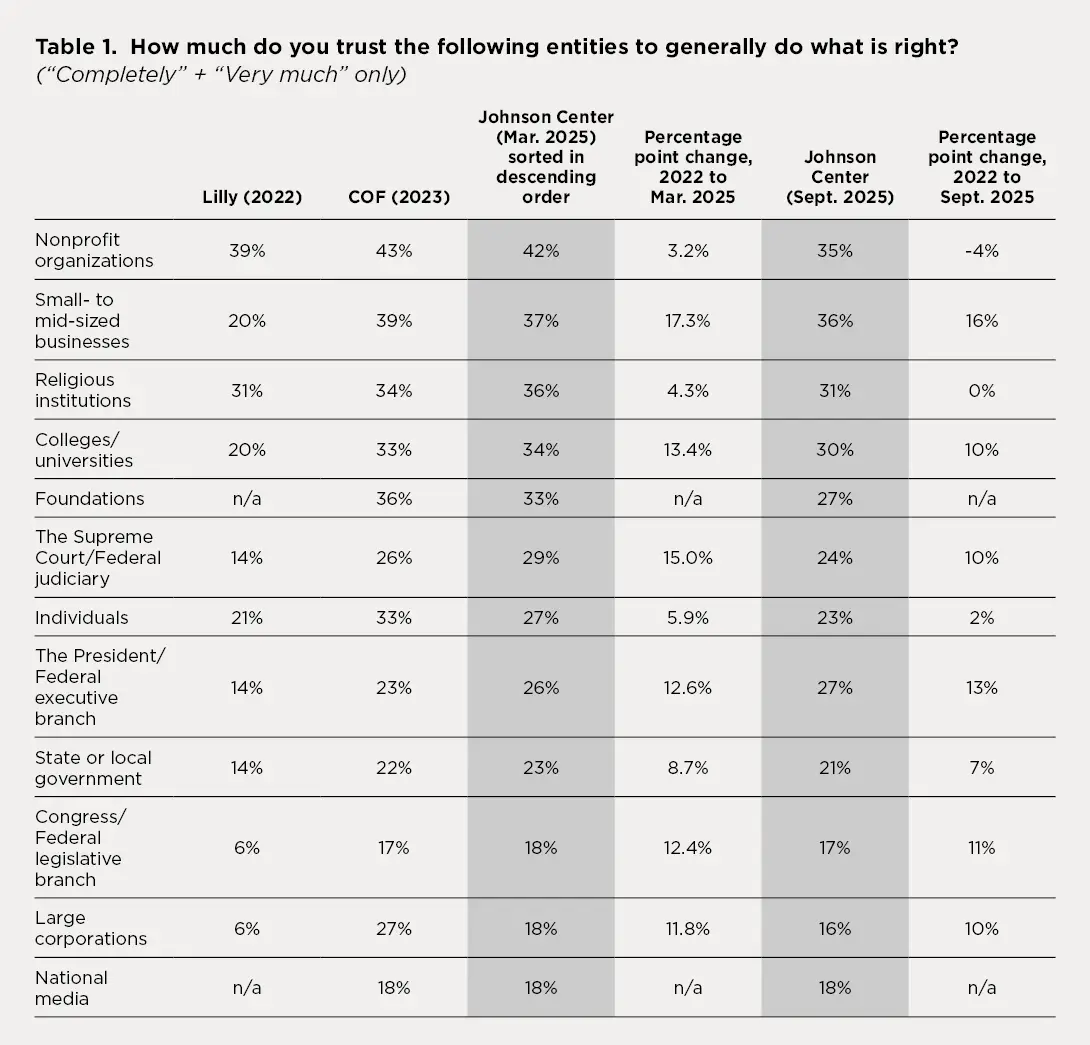
Nonprofits remain among the most trusted institutions, with 42% of respondents expressing strong trust in March 2025. However, that confidence appears to be softening. Six months later, the proportion of those reporting strong trust had dropped to 35%, reflecting a broader downward trend across nearly every institution we measured (see Table 1).
When asked how much respondents trusted various institutions to “generally do what is right,” nonprofits continued to rank at or near the top — but the margin of trust narrowed over time. Smaller, community-based entities tended to inspire higher confidence than large or national organizations. Additionally, local organizations inspire greater confidence — 64% of respondents express a positive view of small and mid-sized nonprofits in their community.[3] This reinforces a growing pattern across studies: proximity creates trust. When people can see an organization’s work and impact directly, they are far more likely to believe in its integrity.
These changes suggest that even traditionally “safe” sectors — those often seen as more insulated or protected from political conflict — are caught in the same gravitational pull of skepticism affecting other major institutions.
Highlights:
Skepticism About Philanthropy is Rising
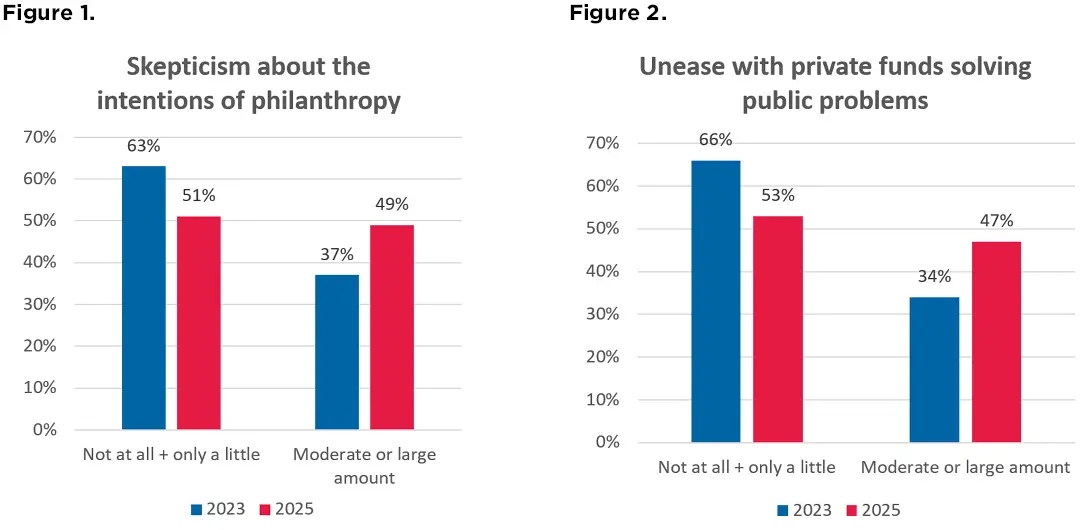
Self-reported public understanding of philanthropy is growing, but that does not necessarily translate into higher confidence. It is likely that an increase in knowledge actually helped the public scrutinize the sector more intensely.
Skepticism about philanthropy extends beyond its perceived intentions — the portion of respondents who feel uneasy about private funds being used to address public problems has also increased. In 2023, nearly two-thirds of respondents reported little or no skepticism about philanthropic intentions; however, data reveal that this ratio has shifted from roughly 2:1 in 2023 to 1:1 in 2025 — a decline of 12 percentage points.
These results mark a notable shift in perception, moving from relative confidence to near parity between trust and doubt. This is only a two-year difference, and as questions of legitimacy and influence intensify, the public remains conflicted about philanthropy’s role in addressing social challenges traditionally managed by the public sector.
Support for Government Oversight of Philanthropy
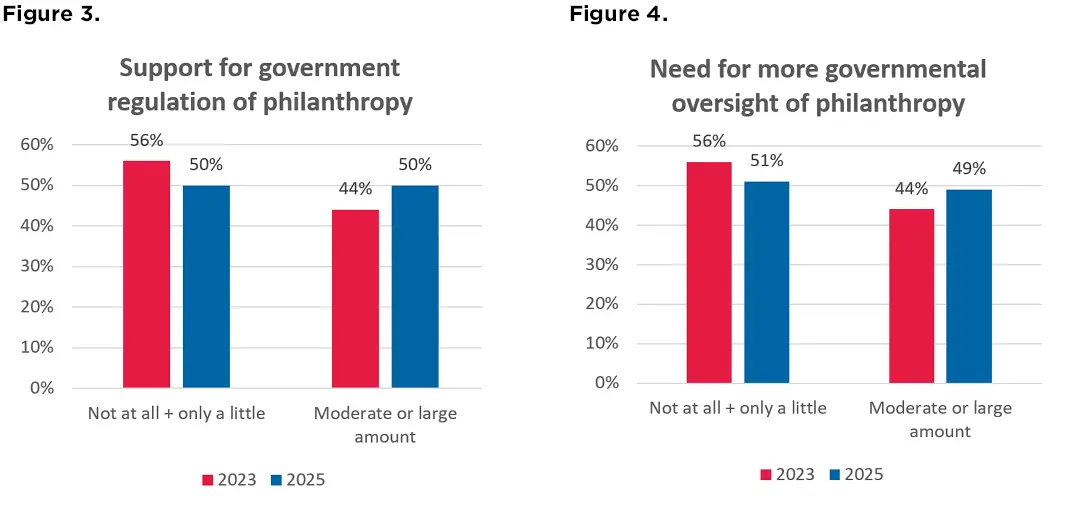
Increased skepticism also means that public support for regulation is growing, although most respondents still favor a light-touch approach by the government to regulating nonprofits. This nuance matters — Americans may want more accountability, but not necessarily more bureaucracy. Since 2023, there has been a slight increase in the share of respondents who believe the government should regulate the philanthropic sector to a moderate or substantial extent.
“Since 2023, there has been a slight increase in the share of respondents who believe the government should regulate the philanthropic sector to a moderate or substantial extent.”
While this shift is slight, it waves a red flag — data suggest that as skepticism grows, tolerance for oversight increases. Additionally, this subtle shift has large implications. While the numbers themselves do not change significantly, the shift is driven almost entirely by a 5% decrease in “not at all” responses and a 5% increase in “large amount” responses. This suggests growing polarization rather than a universal move toward regulation.
Foundation Spending
Because we were concerned about possible slippage in trust across the sector, we added a new battery of questions not included in previous surveys. These questions were designed to explore emerging public perceptions about endowments, funding priorities, and the balance between addressing immediate versus long-term needs.
More people are concerned that foundations are not doing enough than are worried that increased giving now could mean less funding for the future. This has very real implications for future planning and conversations around endowments, as it suggests that “spend-down” consequences are less prominent than frustration with perceived inaction.

Trust in Specific Sector Actors
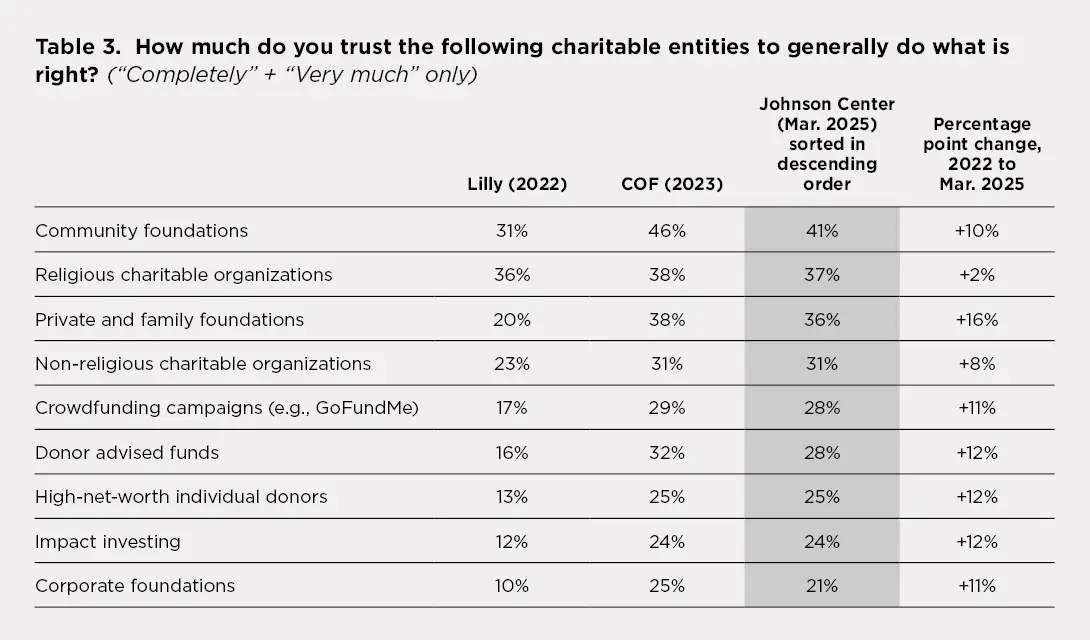
When asked about various entities in the nonprofit and grantmaking sector, no single entity earns a majority of ‘complete’ or ‘very much’ trust to generally do what is right. However, every category saw improvements in trust between 2022 and March 2025. Of particular importance to the sector, this finding suggests that credibility grows when an organization is familiar and transparent. Sub-sectors such as community foundations and religious charitable organizations were close to crossing the majority threshold, indicating that trust remains situational and depends on broader contexts. People’s trust in various entities is highly tied to how those individual entities are perceived in people’s lives.
We are faced with a paradox. On the one hand, people are growing increasingly skeptical of the nonprofit sector, especially as it becomes a key voice in policymaking and political discourse, whether by choice or due to mounting political pressure. On the other hand, trust in certain types of organizations is increasing, especially those perceived as local, transparent, and mission-driven. For example, debates in Spring 2025 about donor advised funds and the speed at which charitable money should be spent triggered criticism and increased scrutiny of some larger foundations. At the same time, local nonprofits and community foundations that were considered to be transparent, local, and dedicated to their mission saw an increase in public trust. This paradox highlights that trust isn’t uniform or guaranteed, nor is it an inherent feature of the nonprofit and philanthropic ecosystem.
Public Sentiment on the Sector’s Direction
Overall, respondents feel that things are on balance — and improving — across the sector over the three years. The share of respondents selecting “don’t know” has decreased, and the proportion indicating the “right direction” is twice as high in March 2025 as in 2022. Despite increased skepticism in the nonprofit and philanthropic sector, the general trajectory is not entirely negative. Americans still see nonprofits as among the few institutions trying to do the right thing, even if their confidence in philanthropy’s motives is mixed.

By keeping exploration at the forefront of this research, we were able to gain a deeper understanding of the dynamics of trust. Our findings suggest that while nonprofits remain among the most trusted institutions, trust in them can no longer be taken for granted. It is increasingly dependent on factors such as proximity, transparency, and the organization’s perceived purpose and authenticity.
“Our findings suggest that while nonprofits remain among the most trusted institutions, trust in them can no longer be taken for granted. It is increasingly dependent on factors such as proximity, transparency, and the organization’s perceived purpose and authenticity.”
The sector still enjoys comparatively more support than businesses or government, but that support is neither universal across different parts of the industry nor unchanged over time. Media coverage, national political debates, and public scrutiny following policy shifts in Spring 2025 are revealing the need to approach evaluating trust in the nonprofit and philanthropic sectors differently — it is less about rankings and more about direction — where trust is strengthening, where it’s slipping, and what those movements reveal about the relationship between institutions and the public.
Looking across the Lilly School (2022), Council on Foundations (2023), and the first Johnson Center (March 2025) surveys, we see three big takeaways:
Trust constantly evolves as perceptions and behaviors change, strengthening and weakening depending on the times. The current trust crisis is very real — but it is not irreversible. To see if higher trust in nonprofit entities translates into higher willingness to share information with nonprofits — or increased knowledge of aspects of charitable giving — read the second blog in this two-part series.
————————-
[1] Fielded March 10 to March 15, 2025, using a nationally representative panel of 800 adults. It is important to note that this survey was fielded before the tariff “liberation day” or the federal action against several nonprofits, including Harvard University.
[2] Fielded September 10 to September 15, 2025, using a nationally representative panel of 800 adults.
[3] Johnson Center (March 2025) survey, “On the whole, how positive or negative do you feel about… Private and family foundations? Community foundations? Small and mid-size nonprofits in your community? Large, national nonprofits?” [very negative, negative, neutral, positive, very positive].