Nonprofits have a trust problem — but not the one you think. According to the 2025 Trust in Civil Society report by Independent Sector and Edelman Data Intelligence, 57% of Americans report high trust in nonprofit organizations to “do the right thing” — a result that stands higher than trust in Congress, large corporations, or national media. As the report states, “public trust is the currency of the nonprofit sector. Without the public’s trust, everything we do to advance our collective missions becomes harder, if not impossible.”
However, the Johnson Center’s research reveals that the sector’s “currency of trust” appears to be non-transferable to the data-driven realities of modern organizational life. While nonprofits may be rich in public goodwill, they remain poor in functional confidence from the same public, operating without meaningful advantages in the very data collection activities that today’s nonprofit work demands.
“[A]s funding grows scarcer and data becomes more critical for demonstrating impact, public willingness to share that data is softening.”
Nonprofits face resistance when they ask people to share personal information — information such as race/ethnicity, age, or income — to better understand their communities and secure funding. This creates a troubling paradox: as funding grows scarcer and data becomes more critical for demonstrating impact, public willingness to share that data is softening. Combined with growing concerns about AI and federal policy changes, nonprofits face mounting pressure to demonstrate outcomes without the data to do so.
The Johnson Center conducted two related surveys in March and September 2025 to probe more deeply into trust in various institutions within and outside the philanthropic sector.
Our initial results focused on trust more broadly and revealed that trust in the nonprofit sector is highly nuanced, dependent on factors such as organizational proximity, transparency, and perceived purpose. While the sector’s overall trajectory shows improvement when viewed over the last several years — with “right direction” sentiment doubling from 2022 to 2025, even including a notable drop from March to September of 2025 — no single entity within the philanthropic ecosystem commands 50% or more individuals reporting “complete” or “very much” trust.
One encouraging finding from our March survey was that small and mid-sized nonprofits within local communities tend to be in an even stronger position, comparatively. People are more likely to feel positively toward organizations they know or perceive as actively improving their everyday lives and communities.

We asked respondents about ten types of demographic information commonly requested when enrolling or applying for services. Specifically, we asked respondents to select the three types of information they were most comfortable sharing with nonprofit organizations, and the three types they were least comfortable sharing.
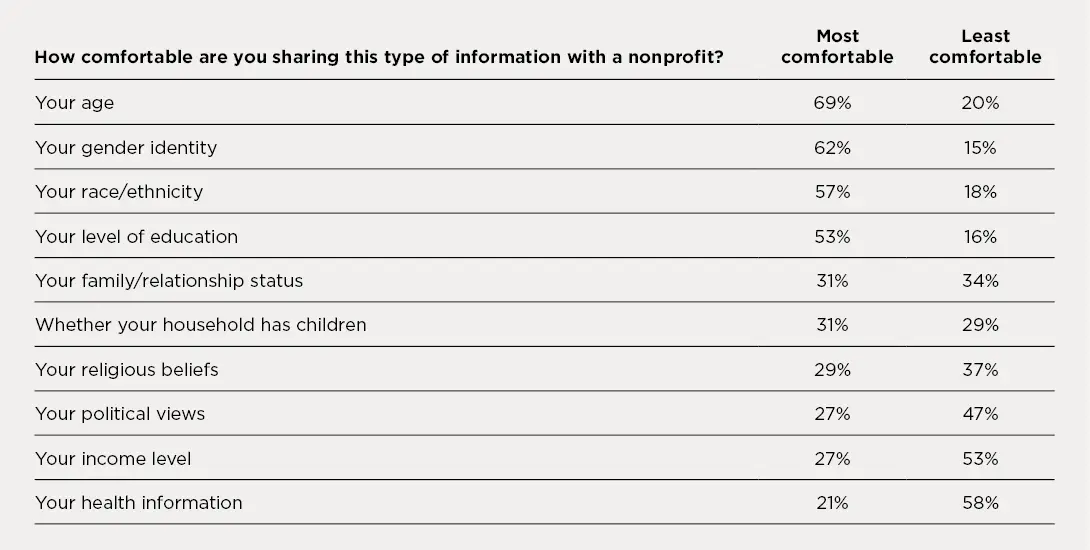
More than half of all respondents were comfortable sharing their age, gender, race, and level of education to receive a product or service from a nonprofit. Conversely, roughly half or more were least comfortable sharing health information, income level, or political views. However, another survey question revealed a major contradiction: while 65% of respondents said it is very or extremely important to know how their data will be used, 82% have never declined to provide personal data, and 86% have never regretted sharing. As Giving Tuesday research shows, this gap matters because trust directly impacts giving: people with higher nonprofit trust are nearly twice as likely to donate and more likely to sustain or increase their contributions.
“[W]hile 65% of respondents said it is very or extremely important to know how their data will be used, 82% have never declined to provide personal data and 86% have never regretted sharing.”
Our September survey explored two key drivers behind the public’s increasing hesitancy:
Public policy:
When asked whether they were more careful about sharing personal information with nonprofits now than they were last year due to policy changes in Washington, D.C., more than three in four respondents agreed (77%).Additionally, just over half of respondents reported feeling they had little or no control over how their personal data is used, and fewer than one in five reported having a lot or a great deal of control.
As we noted above, the public has historically had high trust in nonprofits to “do the right thing.” With this in mind, we hypothesized that nonprofits may have an advantage in collecting personal data. In the end, our data did not support this.
We asked respondents about 14 entities that frequently collect information. For each, we asked how confident respondents were that the organization could keep their personal data and that of their family or household secure from breaches or unauthorized access.
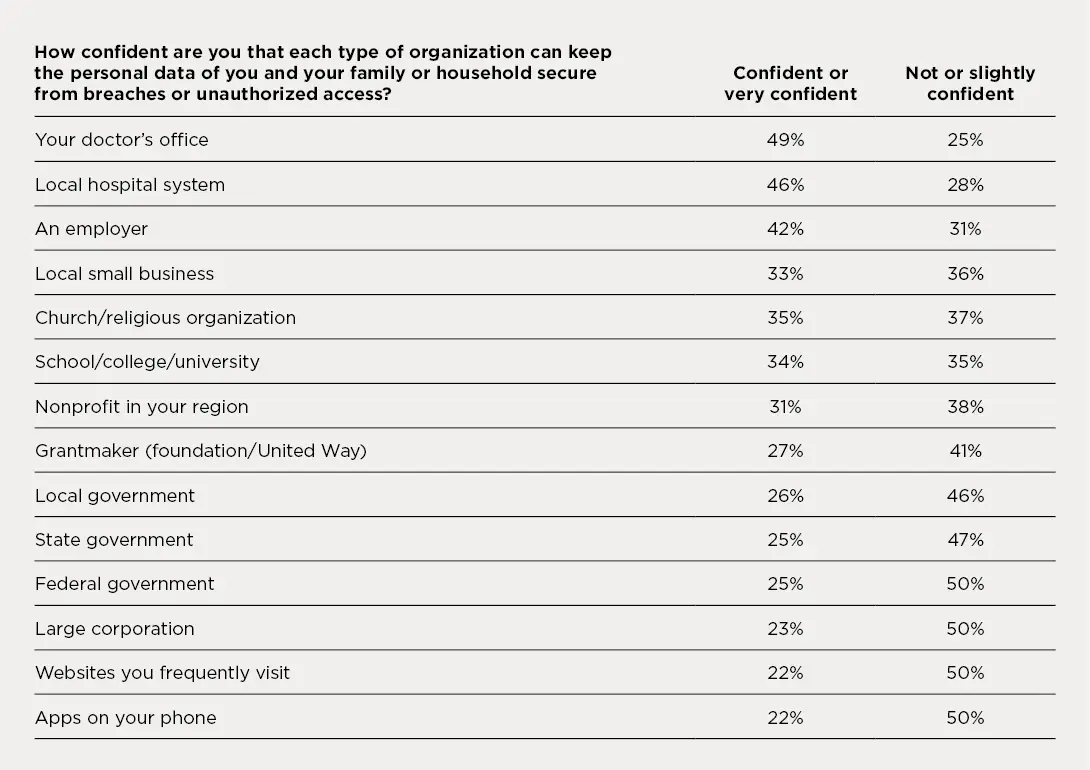
These results give us a better idea of the level of nuance involved with trust and data privacy. They ultimately reveal a slightly troubling pattern:
Healthcare professionals hold more data security confidence with the public than any nonprofit type we asked about.
Local nonprofits barely surpass local government. At 31%, regional nonprofits hold just slightly more data security confidence than local government (26%) and practically tie with local small businesses (33%).
It is true that nonprofits continue to rank among the most trusted institutions for doing the right thing; however, they perform no better than government or corporations when it comes to public confidence in protecting personal data.
Statistician Nate Silver emphasizes in his book, The Signal and the Noise, that “data is useless without context.” For nonprofit organizations, that context — understanding who they serve, what outcomes they achieve, and which strategies work — depends enormously on collecting personal information. The gap growing between general trust in nonprofits and data security confidence underscores multiple operational challenges. Food banks, housing services, and other nonprofits now face skepticism the moment they ask for participants’ income or health information. Nonprofits must start gathering data as sensitively as a doctor’s office would, but without the baseline trust that things like HIPAA and professional licensing provide.
Ultimately, public willingness to share data is dropping; the public’s run-of-the-mill openness that nonprofits have long benefited from is dwindling. Organizations can no longer assume people will share information simply because they are asked — nonprofits must actively earn and sustain confidence.
Nonprofits are facing huge challenges driven equally by unpredictable federal policy changes and funding uncertainty. The Urban Institute reports that, in the first 4-6 months of 2025, a third of nonprofits reported funding disruptions. Digging a bit deeper, that means that roughly
One in five nonprofits (21%) reported losing at least some government funding;
One in four nonprofits (27%) reported experiencing a delay, pause, or freeze in government funding; and
The fragility of historically stable funding streams means nonprofits need data now more than ever to tell their story to potential supporters, policymakers at every level, and the public.
Resources like the AAMC Health Justice Trustworthiness Toolkit outline actionable principles that translate across sectors. The toolkit highlights three main actions organizations can take to earn trust:
Transparency in how you use data:
Explain clearly what information you are collecting, why it is necessary, and how it will be protected and used.Reciprocity in relationships with communities:
Ensure data collection benefits the people sharing information, not just organizational needs.Changes in approach such as these should not be considered aspirational or even optional — they are operational necessities. When only 31% of the public feels confident in regional nonprofits’ ability to protect data, every intake form, every email subscription, every donation processed, and every participant survey becomes a test of institutional credibility — and an opportunity to strengthen bonds. While nonprofits enjoy high trust relative to other institutions, we cannot take that trust for granted. With intentional action, nonprofits can close the gap between mission trust and operational confidence — one transparent data practice at a time.