 This article was first published in our 11 Trends in Philanthropy for 2026 report. Explore the full report here.
Want the latest trends, research, and more delivered right to your inbox? Subscribe to the Johnson Center’s email newsletter.
In 11 Trends in Philanthropy for 2021, Martin (2021) highlighted that although nonprofits are trusted more than other institutions, their position is tenuous. She shared three ways to buoy public opinion: increase transparency, elevate constituent engagement, and maintain a commitment to equity. While these recommendations have typically been a surefire way to establish trust with communities, research suggests there is much more to the equation.
Nonprofits fulfill an essential role in society. Recognized as “society’s safety net,” they often provide vital social services when the government falls short (Lynch, 2025). Even so, public trust in nonprofits is showing signs of wear (Moore, 2025).
Independent Sector and Edelman Data Intelligence (2025) found that in the years 2024 and 2025, only “57% of Americans report[ed] high trust” in nonprofits (p. 7). While 57% is a majority, it is hardly a landslide.
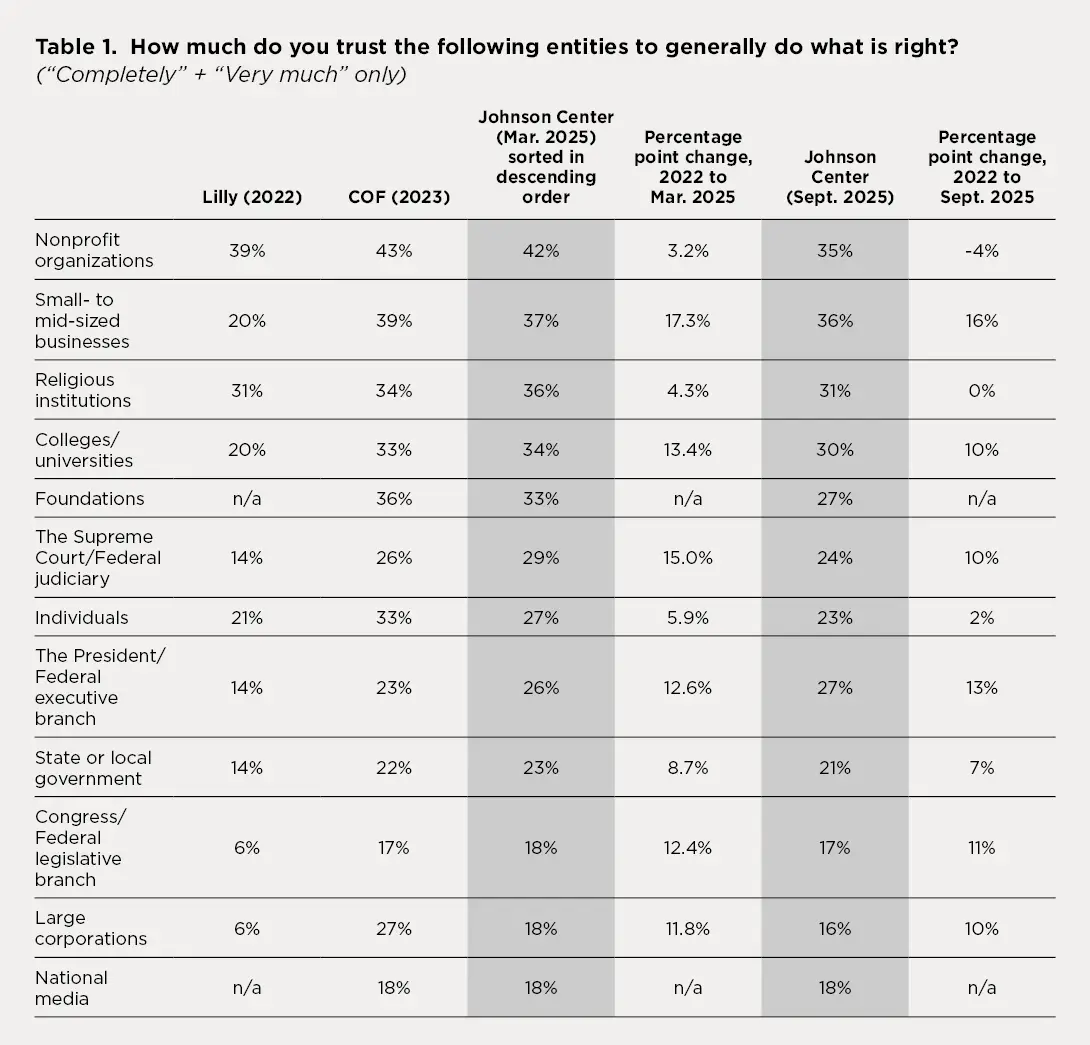
In March 2025, the Johnson Center deployed a national survey to revisit public trust in institutions. The research is intentionally in conversation with data from both Indiana University’s Lilly Family School of Philanthropy (2022) and the Council on Foundations (COF) (2023). From when those surveys were published to when the March survey was conducted, trust in nonprofits appears to have generally grown — from 39% in 2022, to 43% in 2023, to 42% in 2025.
However, when the survey was fielded again in September 2025, the results revealed that most nonprofits had experienced a decline in trust over the course of six months. By September, only 35% of respondents reported high trust in nonprofits (Doebler & Williams, 2025).
Notably, Edelman’s Trust Barometer (2025, pg. 24), a study separate from but related to Edelman’s work with Independent Sector, measures trust using two dimensions: trust in a sector to generally act ethically, and trust in a sector to generally act competently. Nonprofits are on par with businesses and outperform the government and media in the U.S. on ethical conduct. But when competence is the question, nonprofits’ performance is middling and still in the red (Edelman Trust Barometer, 2025, pg. 17). Business is the only sector that U.S. respondents trust to act both ethically and competently.
Part of the problem is how competence is perceived; the nonprofit sector’s impact is tough to measure and communicate in ways that matter to the public (Searle, 2025). How do you quantify the value of a child who does not end up in the juvenile justice system because of an after-school program? Or measure the ripple effects of a community health initiative that prevents chronic illness years down the road? These outcomes are real and valuable but resist simple measurement.
“How do you quantify the value of a child who does not end up in the juvenile justice system because of an after-school program? Or measure the ripple effects of a community health initiative that prevents chronic illness years down the road? These outcomes are real and valuable but resist simple measurement.”
This creates a tension between storytelling and data. Whether for reporting purposes or internal tracking, many nonprofits report impact by “counting heads and dollars — sharing the number of events held, people served, volunteers engaged, dollars raised or other similar metrics” (Crowder & D’Avanza, n.d.). Although these numerical details are undoubtedly essential to track, they should not be decoupled from the many powerful individual stories behind them.
Many nonprofits feel stuck between these two approaches, unsure of which strategy will truly build trust: collecting the numbers or sharing the stories. The question is further complicated by the demands of funders. Some funders want rigorous evaluation and detailed metrics, while other donors respond more to compelling stories (fundsforNGOs, 2025). The result is that many organizations are simultaneously over-reporting to some audiences and under-communicating to others, exhausting themselves in the process without necessarily building public confidence in their competence.
Moreover, the social problems nonprofits tackle are often intergenerational, intersectional, and influenced by factors far beyond any single organization’s control (fundsforNGOs, 2025). A program for unhoused folks can provide shelter and job training, for instance, but it cannot independently also address the lack of affordable housing policy in a region or decades-long wage stagnation. This complexity makes it difficult for nonprofits to demonstrate clear cause-and-effect relationships between their work and real-life change.
The reality is that trust in the sector exists within a broader ecosystem that either supports or diminishes confidence in the sector’s work.
Consider the role of media coverage. Local news outlets, which historically cover nonprofit achievements and community events, have drastically decreased in recent years (Abernathy, 2022; Hastings, 2024). When nonprofits do make the headlines, it is often in the context of scandal or controversy rather than innovation or impact. The result is a skewed impression of the sector: failures make headlines, while the organizations serving their communities with care and competence rarely do.
Funders, too, play a complicated role in the trust equation. While they rightfully want accountability for their investments, some reporting requirements work against trust-building. When nonprofits spend significant staff time producing detailed reports for multiple funders, each with different formats, metrics, and timelines, those hours are not being spent on direct service delivery or community engagement. The public sees organizations stretched thin and wonders about efficiency and know-how, not realizing how the administrative burdens built into our sector can drain time and resources (Howard, 2025). Restricted funding that prohibits investment in infrastructure, technology, or communications capacity further hampers nonprofits’ ability to demonstrate and share their impact effectively.
“The public sees organizations stretched thin and wonders about efficiency and know-how, not realizing how the administrative burdens built into our sector can drain time and resources.”
In 2025, many organizations worked to address the challenges of public storytelling. The National Council of Nonprofits (2025) and COF (2025b) both launched public awareness campaigns — Nonprofits Get it Done and Giving is Here for Good campaigns, respectively — providing flexible messaging, graphics, and guidance for their networks to adopt and adapt. The Council on Foundations (2025a) and the University of Florida’s Center on Public Interest Communications launched the learning series Better Stories, Better Language over the summer to help communications staff leverage recent research on bridging language. And The Chronicle of Philanthropy’s new monthly opinion column, Watch Your Language, is intended “to help nonprofit professionals reduce jargon and communicate in ways that build trust and understanding of the sector.”
Funders are also seeing the need to help nonprofits invest in their storytelling. Vanguard Charitable’s Philanthropic Impact Fund (2025) specifically offered grants under the “Shifting the Narrative around the Nonprofit Sector” (Watkins, 2025).
The more organizations are equipped to take on the work of accessible storytelling around both ethics and competence, the more benefits the whole sector is likely to see. For nonprofits, success relies on having your community’s trust — without it, organizations cannot serve effectively or influence social change (Purdy, 2024).
Still, fundamental questions remain that the sector must grapple with collectively:
In a time of social and political turbulence, answering these questions is not optional, it is essential. The sector’s ability to serve communities effectively depends on the public’s belief that nonprofits are not just well-intentioned but genuinely capable of creating the change our society needs.
Abernathy, P. M. (2022). The state of local news: The 2022 report. Northwestern University Local News Initiative. https://localnewsinitiative.northwestern.edu/research/state-of-local-news/report/
Council on Foundations. (2025). Better stories, better language. https://cof.org/page/better-stories-better-language-communications-workshop-series
Council on Foundations. (n.d.). Giving is here for good. https://cof.org/givingishereforgood
Crowder, J., & D’Avanza, L. (n.d.). Why nonprofits must think differently about measuring and reporting impact. Nonprofit Leadership Center. https://nlctb.org/tips/communicating-nonprofit-impact/
Doebler, E., & Williams, J. (2025, December 3). Public trust in transition. Dorothy A. Johnson Center for Philanthropy at Grand Valley State University. https://johnsoncenter.org/blog/public-trust-in-transition/
fundsforNGOs. (2025, February 8). The challenges of measuring social impact for nonprofits. https://us.fundsforngos.org/articles/the-challenges-of-measuring-social-impact-for-nonprofits/
Hastings, D. (2024). The decline of local newspapers. Close Up Foundation. https://www.closeup.org/the-decline-of-local-newspapers/
Howard, H. (2024, June 4). How to simplify grant applications and reports for nonprofits. Exponent Philanthropy. https://exponentphilanthropy.org/blog/how-to-simplify-grant-applications-and-reports-for-nonprofits/
Independent Sector, & Edelman Data and Intelligence. (2025, July 10). Trust in nonprofits and philanthropy. https://independentsector.org/resource/trust-in-civil-society/
Lynch, M. G. (2025, July 31). The social safety net: How nonprofits support and contribute to our local communities in need. The Open Link. https://theopenlink.org/news-events/newsroom.html/article/2025/07/31/the-social-safety-net-how-nonprofits-support-and-contribute-to-our-local-communities-in-need
Martin, T. (2021, January 19). The nonprofit sector has a unique opportunity to build public trust. 11 trends in philanthropy for 2021. Dorothy A. Johnson Center for Philanthropy at Grand Valley State University. https://johnsoncenter.org/blog/the-nonprofit-sector-has-a-unique-opportunity-to-build-public-trust/
Mikaelian, A. (2024). Why transparency matters more than ever. The Chronicle of Philanthropy. https://philanthropy.org/why-transparency-matters-more-than-ever/
Moore, L. (2025, August 13). Is the nonprofit sector facing a trust deficit? Forbes. https://www.forbes.com/councils/forbesnonprofitcouncil/2025/08/13/is-the-nonprofit-sector-facing-a-trust-deficit/
National Council of Nonprofits. (2025). Nonprofits get it done. https://nonprofitsgetitdone.org/
Purdy, J. (2024, July 15). The role of trust in non-profit and community benefit organizations. FIC Human Resource Partners. https://www.fichrpartners.com/post/the-role-of-trust-in-non-profit-and-community-benefit-organizations
Searle, S. (2025, February 19). A practical guide to nonprofit measurement, evaluation, and learning. The Bridgespan Group. https://www.bridgespan.org/insights/nonprofit-organizational-effectiveness/a-practical-guide-to-nonprofit-measurement-evaluation-and-learning
Smith, M. (2025, June 4). How to simplify grant applications and reports for nonprofits. Exponent Philanthropy. https://exponentphilanthropy.org/blog/how-to-simplify-grant-applications-and-reports-for-nonprofits/
Vanguard Charitable. (2025). Philanthropic Impact Fund. https://www.vanguardcharitable.org/philanthropic-impact-fund
Watkins, M. (2025). 7 words that can restore trust in philanthropy. The Chronicle of Philanthropy. https://www.philanthropy.com/opinion/trust-philanthropy-jargon-language/