


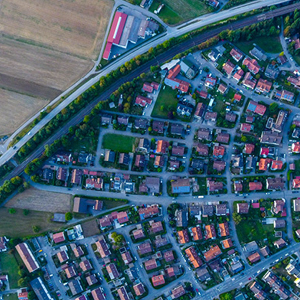






11 Trends in Philanthropy for 2026
Anticipate and embrace what’s next.


This year marks a milestone for the Johnson Center: the tenth edition of our 11 Trends in Philanthropy report. What began in 2017 as a modest supplement to our annual report has grown into a widely read and discussed publication, reaching more than 100,000 readers each year.
Each year’s report is really a compilation of 11 separate articles, each individually researched, written, and reviewed by teams of authors from the Johnson Center. Typically, these articles explore new shifts or evolving movements across the field of philanthropy.
For this tenth edition, however, we have taken a different approach. Rather than identifying a wholly new set of emerging trends, we have turned our attention backward to reflect on the themes that have shaped our sector over the past ten years, and to name both enduring shifts and new developments.
This reflective lens is not just a nod to our anniversary. It is also an acknowledgment of the moment we find ourselves in — a moment of hyper disruption, that combines both great anxiety about where we are headed and great possibility for what could come next. Our future feels more uncertain than ever, but the opportunity to create and scale life-changing innovations for our communities feels present, as well.
One of the biggest challenges philanthropy faces as it seeks to plan for and build that future is that our day-to-day landscape is shifting so rapidly and in so many directions. As executive orders, legal contests, and legislative debates play out, we do not have a clear picture of how much federal funding has been rescinded or withheld from nonprofits and communities. We do not know how many nonprofits have closed or will close their doors, how many staff have lost their jobs, or how many communities have lost access to critical services. We do not know how many donors have paused or limited their giving out of economic anxiety, or how many foundations have shifted strategies in response to the moment. The data are incomplete, the timelines are unclear, and the reality on the ground keeps changing.
In this environment, our best path forward is not to predict or assert, but to reflect. To remember, as Shakespeare reminds us, that “what’s past is prologue” — no matter how different the world may look today, we are still carrying with us everything that came before.
So, as a field, we encourage you to look back with us at what we have learned in order to carry those lessons forward. To ask better questions. To celebrate our strengths while acknowledging the complexity of the systems we are trying to impact. To weave together research, data, stories, and conversations in an effort to make sense of the world we are living in. And, as this 11 Trends project has always aimed to do, to offer ideas — not answers — about what might come next.
Thank you for joining us.

Nonprofits fulfill an essential role in society. Recognized as “society’s safety net,” they often provide vital social services when the government falls short. Even so, public trust in nonprofits shows signs of wear after decades of declining trust in all institutions, and a particularly volatile 2025. The sector’s ability to serve communities effectively depends on the public’s belief that nonprofits are not just well-intentioned but genuinely capable of creating the change our society needs. Storytelling efforts must focus no only on the sector’s ethical work, but on its competence, as well.

Responsible use of AI begins with an honest understanding of its current limitations and harms, including inherent biases, heaving energy costs, and the widespread use of personal data. As formal and informal workplace use of these technologies skyrockets, many of these realities are putting on-the-job AI use in direct conflict with organizational missions. Philanthropic organizations that put thoughtful AI policies in place now will be better equipped to use these tools responsibly while avoiding unintended harm in the future. Frameworks and case studies for informed use are increasingly emerging.

Hundreds of public radio and public broadcasting stations are at risk across the country following the closure of the Corporation for Public Broadcasting (CPB) in 2025. While nonprofit media (aligned with but distinct from public media) continues to gain ground and strength, CPB’s loss is a seismic blow to the whole field. Stations, donors, institutional funders, and others are racing to rally new sources of support, but major questions remain about whether emergency response measures can be successfully pivoted into strategies for long-term sustainability.
Many of our most enduring challenges defy easy market solutions — a truth that has driven centuries of government services and philanthropy. However, with the federal government now sweeping backwards from the role it has long played in funding the U.S. and global economies (including vital services), both philanthropy and business have much at stake, and much to gain by working together. Still, navigating the tension between business goals and social goals will be a natural part of any partnership or crossover between these two spheres.

As people and organizations in the social impact ecosystem look to add agility, focus impact, offset burnout, and ultimately, protect their best interests, some of philanthropy’s familiar structures are falling away. Collectively, these experiments signal a likely welcome departure from traditional, more hierarchical forms — but they raise new questions, as well. Resolving emerging tensions will require robust public engagement, openness from the philanthropic sector, and a legal framework that accommodates creativity without sacrificing accountability.
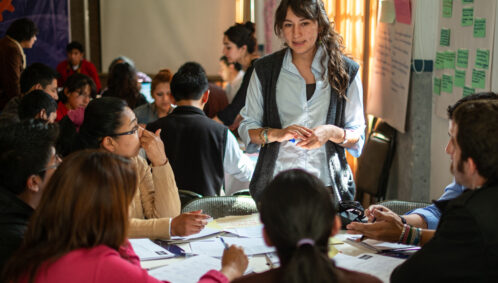
As the frequency and scale of natural disasters continue to climb, grassroots organizations, Indigenous communities, and major funders and others are all pushing to fill the gaps left by disappearing federal funding, research teams, and entire agencies. Place-based solutions, especially, are leveraging unique local knowledge and investments to chip away at a global challenge.
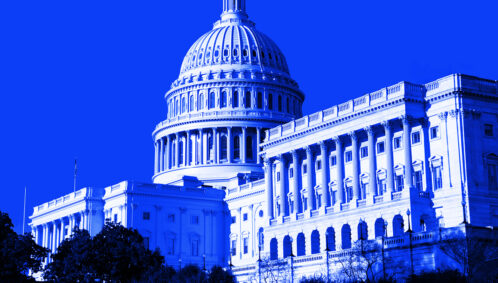
For years, we viewed government and philanthropy as partners: sometimes uneasy but aligned in purpose. The enormous disruptions in federal funding and priorities we experienced in 2025, however, not only showed how intricately connected the two sectors are, how created a level of tension and even animosity that suggests these two longtime partners may be becoming adversaries. The people who rely on government and nonprofit services are caught in a new tug-of-war.

Fewer federal datasets are publicly available to researchers today than even a year ago. Eroding trust in data and institutions has led to new obstacles in data collection and dissemination. Additionally, artificial intelligence remains a source of both great power and great risk. The future of the data landscape for philanthropy is now dependent on the development of new avenues for data collection and community engagement, advocacy for maintaining public dataset availability, and an emphasis on responsibly generating data stories to inform decision-making.

The 2020s have forced a reckoning with how employers do — or don’t — invest in staff well-being. The nonprofit and philanthropic sector has long wrestled with high rates of burnout, resource and funding “starvation cycles,” and a mismatch between capacity and demand. Sweeping federal cuts and uncertainty among new and long-time donors have left countless nonprofits scrambling for the funds they need to support their communities, leaving little left over to support staff well-being for the long haul. And for a sector grounded in “love for humanity” — the meaning of the word “philanthropy” itself — the crises playing out in communities everywhere take their own toll.

Many individuals, families, and institutional donors spent 2025 in a state of paralysis, overwhelmed by uncertainty, concerned for their safety as philanthropic actors and organizational leaders, and unsure where their giving could be most effective. In the midst of rising political violence, federal attacks on the nonprofit and philanthropic sector, and a barrage of crises, donors of all kinds and at all levels are considering the political nature of giving.

The philanthropic ecosystem has always included an incredibly diverse range of practices, institutions, giving vehicles, causes, and people. Yet, the field has often been narrowly defined and understood as the province of wealthy, typically white individuals. Generosity has only been counted in dollars and hours. But with growing demand for personal and community agency in solving real-world challenges, the proliferation of digital platforms that ease connection and giving, and a sector eager to embrace and uplift more forms of engagement, the landscape of philanthropy is changing quickly.
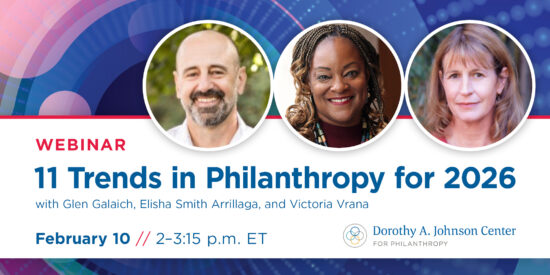
Watch the engaging discussion with our guest panelists about how our sector has evolved over the past decade and what the future may bring. Learn about specific key trends and macro-level forces shaping — and being shaped by — philanthropy practitioners and colleagues in other sectors. Hear from some of the leading voices in philanthropy working to contextualize public debates, offer alternatives and solutions, and support the people most impacted by change, and consider how these trends will affect your work and relationships in the months and years ahead.