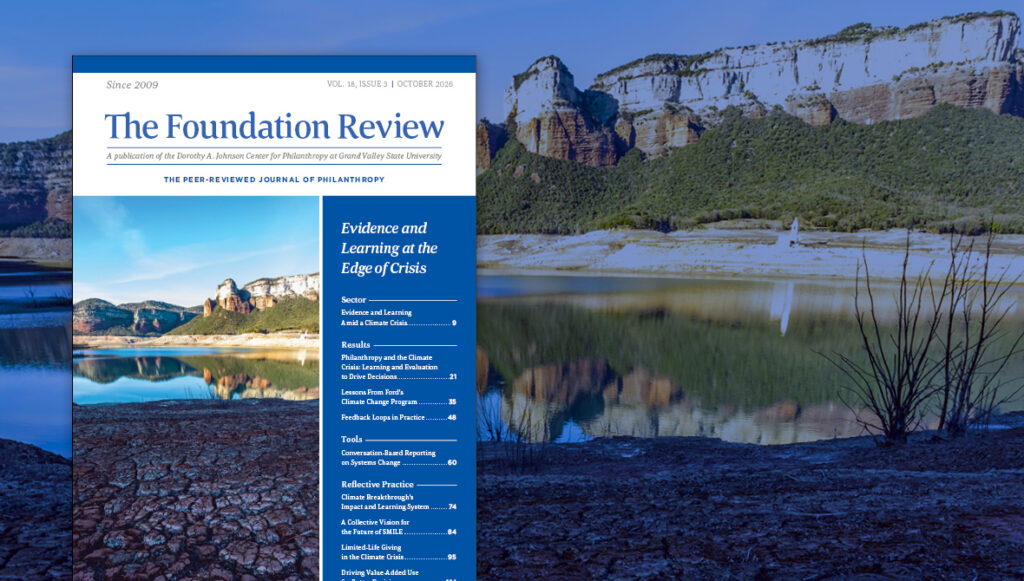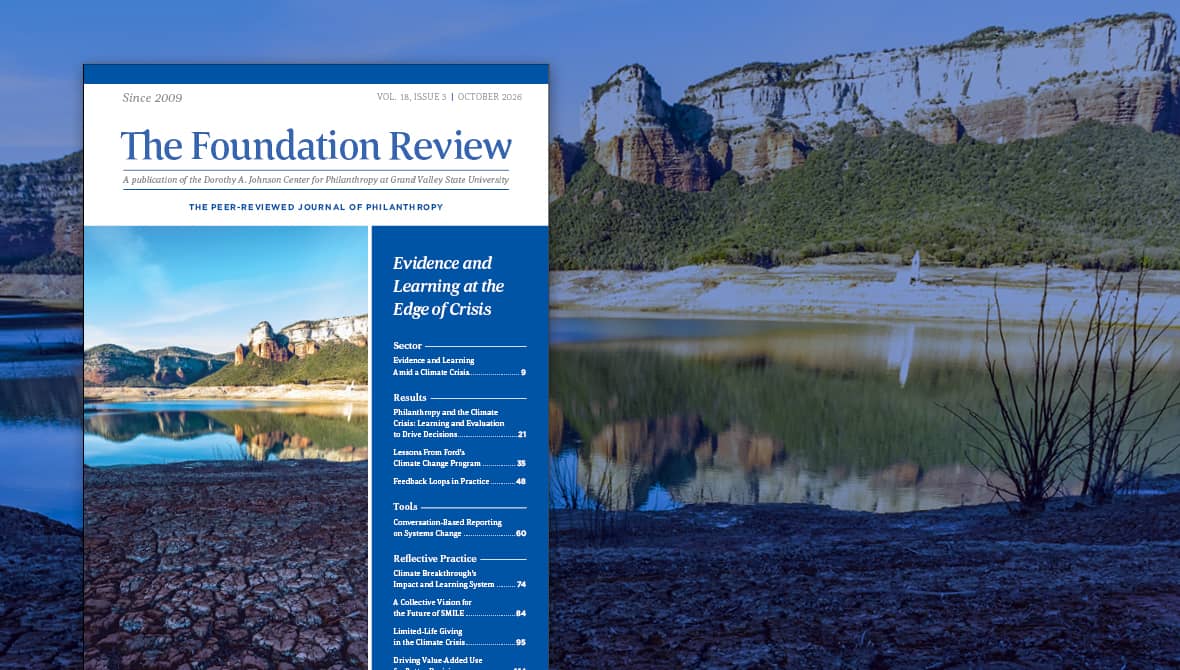
In 2024, I was fortunate to be in the room when The Rockefeller Foundation convened a group of stakeholders from across the climate learning and evaluation ecosystem to grapple with how to strengthen the relevance of evidence and learning in addressing the climate crisis. Those group discussions revealed a clear, collective recognition that the evaluative practice most of us were trained in was built for a slower and steadier world than the one we are in.
This issue of The Foundation Review grew out of that recognition. It recommends changes to how we approach learning and evaluation so that it can better support efforts to contend with the complex and fast-moving climate crisis.
The issue opens with an article that frames these ideas. Larson, Hoffman, and Lahowin identify six frontiers that can be pushed further and applied in new ways to address the mismatch between the evidence and learning practices our field has inherited and what decision-makers need: (1) focusing on transformational and systems change, (2) attending to causal relationships, (3) emergent learning and adaptive management, (4) strategic foresight amid uncertainty, (5) technology-enabled approaches and AI, and (6) attention to justice and equity.
The issue’s remaining articles offer real-world examples of these practices. Each focuses on one or more parts of the six-frontier map.
Together, these articles show that the field is already working on the frontiers named in the issue’s first article. The work ahead is to keep building toward them. We hope these articles offer inspiration for this essential work.


Special thanks to The Rockefeller Foundation for their generous sponsorship of this issue!
In response to the question of how to strengthen the relevance and impact of evidence and learning in addressing the climate crisis, the authors identify six frontiers for advancing practice: (1) transformational and systems change, (2) attending to causal relationships, (3) emergent learning and adaptive management, (4) strategic foresight amid uncertainty, (5) technology-enabled approaches and AI, and (6) justice and equity.
The MacArthur Foundation’s decade-long Climate Solutions Big Bet offers a concrete example of evaluation advancing systems transformation across a program’s full lifecycle. Built from the outset so that evaluation and strategy would reinforce each other, the Big Bet’s evaluation partnership connected evidence to decisions, built relationships and accountability, and effectively navigated setbacks.
From the Ford Foundation, this account details what it takes to subject a complex social change strategy to genuine evaluative scrutiny. It covers how the Office of Strategy and Learning centered equity in selecting an evaluator, the relational work needed to build buy-in across leadership and program teams, and how findings ultimately informed climate strategy decisions about what and whom to support.
The authors present the learning journey of a complex, systems-focused climate philanthropy initiative that used structured feedback loops as an evaluation design. They describe how loops were implemented over two years, discuss the choice of complexity-aware methods, and analyze the relational and power dynamics navigated by the funder, regranter, and evaluation team.
The Climate Emergency Collaboration Group shifted from using written grantee reports with predetermined indicators to conversation-based reporting (CBR), prioritizing depth and meaningful two-way exchange. This article covers CBR’s origins in philanthropy and within the organization, the approach’s evolution based on piloting, and how to mitigate key challenges and tensions in the process.
Climate Breakthrough’s impact and learning support for grantees has revealed two key lessons: funders need to resource a full toolkit for impact and learning and not just focus on climate-related metrics, and funders need to let grantees help define what evidence of progress actually looks like to understand the full breadth of a grantee’s work.
Arguing that the evaluation field is both misdefined and underleveraged in climate philanthropy, the authors propose redefining the field more broadly as SMILE (Strategy, Monitoring, Impact, Learning, and Evaluation). After three years of building field-wide learning infrastructure toward this purpose, they reflect on the field’s progress and offer recommendations for further growth.
Using case studies from Australia’s clean energy transition, this article shows how a fixed time horizon at a spend-down foundation shaped philanthropic behavior – forcing fast, collaborative, bold funding; concentrating capital; and using learning to drive and sustain impact. Findings show how a finite timeframe combined with trust-based grantmaking can build lasting field infrastructure and encourage diversified funding.
The ecosystem of tools used to generate and apply climate evidence is evolving, but its use is limited by barriers such as misalignment with decision needs, deep uncertainty, institutional incentives, and limited capacity for collective sensemaking. Philanthropy’s greatest leverage, the authors argue, lies not in more evidence but in strengthening the systems that interpret, govern, and embed it in decisions.