









Partners No More? Government and Philanthropy Navigate a Fractured Relationship
by Jill Roof and Jeff Williams

 This article was first published in our 11 Trends in Philanthropy for 2026 report. Explore the full report here.
Want the latest trends, research, and more delivered right to your inbox? Subscribe to the Johnson Center’s email newsletter.
Over the years, the Johnson Center has chronicled the relationship between philanthropy and government and the enduring impact of politics and government funding on the independent sector. For years, we viewed government and philanthropy as partners: sometimes uneasy but aligned in purpose. Although the evolving nature of this relationship has been a recurring topic in our Trends reports, no one fully anticipated the level of disruption we saw in 2025, suggesting that these two longtime partners may be becoming adversaries.
In 2018, we explored how efforts to repeal the Johnson Amendment, which forbids 501(c)(3) nonprofits from endorsing or deriding any candidates for public office, could change the game for nonprofits (Caldwell & Downey). In that Trends essay, we assumed any change would come from legislative action. While that particular push failed, the voice of nonprofits in electoral politics remains unsettled. What the prior trend did not foresee was that, by 2024, the game would change again — this time via potential judicial action.
A lawsuit filed in federal court in Texas in August 2024 alleged that the nonpartisanship provision of the Johnson Amendment violates free speech. In the second half of 2025, the IRS and the two plaintiff churches agreed to a consent judgment that, if approved, would prevent enforcement of the Johnson Amendment against those two churches (Aprill, 2025). Regardless of the outcome, this ruling will not immediately change how the IRS has enforced the Johnson Amendment with other churches in the past (i.e., the IRS has not generally enforced the Amendment against political statements made from the pulpit in practice) (Hauser & Duniway, 2025). Still, an adverse ruling raises future uncertainty about the applicability of the neutrality envisioned by the Amendment to churches, nonprofits, and foundations toward politics.
Opinions about what comes next vary widely. According to the National Council of Nonprofits (2025) and many nonprofits themselves (including many houses of worship) (Leddy, 2025), repealing the Johnson Amendment for all nonprofits risks politicizing charitable nonprofits, houses of worship, and foundations, furthering national political divisions. A narrow carve-out exempting religious organizations from the Amendment may be challenged as unconstitutional favoritism toward religious nonprofits over secular nonprofits, according to the Americans United for Separation of Church and State and other entities (Hauser & Duniway, 2025).
At the time of writing, the consent decree was still under consideration by the judge, and no final ruling has been issued. Therefore, nonprofits, foundations, and houses of worship alike — and their donors — are in a holding pattern, with major unanswered questions.
Outside of electoral politics, tax policy and changes in government funding continue to impact nonprofit revenues in ways that are hard to predict and plan for, though we did try in Trends essays for both 2019 (Caldwell & Murray-Brown) and 2025 (Abalo & Williams).
But while those essays cautioned tax policy that could destabilize or harm nonprofits, the story in 2025 was how basic cash flow reliability, or lack thereof, could have similar effects. Via turbulent funding policies throughout the year and the October 2025 federal government shutdown (Wessel, 2025), nonprofits and communities across the nation learned that government funding instability due to funding delays and stop-work orders could be just as damaging as direct funding cuts.
An Urban Institute report (Tomasko et al., 2025) using data from the National Survey of Nonprofit Trends and Impacts found that one-third of nonprofits experienced disruptions of federal, state, or local government funding in 2025. Further, nonprofits that experienced a funding disruption were also more likely to report subsequent reductions to staff, programming, and hiring. Other nonprofits reported that these disruptions, even if they did not affect them directly, have altered the funding landscape, leading to increased fundraising challenges.
The Johnson Center further explored this trend of disrupted government funding in a blog post on the complex relationship between nonprofits and government revenue (Williams, 2025), finding that policy and funding changes reverberate throughout an economy dependent on the nonprofit sector for delivery of essential services. Recent funding cuts have directly eliminated funding for nonprofits, while government program cuts have increased the need for nonprofit services. The result has been not only significant workforce disruption for the sector, but new and urgent challenges for communities seeking food supplements, health care and housing supports, legal assistance, and more.
“As nonprofits are asked to do more with less, we need to be cognizant of the challenges, unclear boundaries, and unrealistic expectations that are created when philanthropy begins substituting for, or flat-out supplanting, the traditional roles of government.”
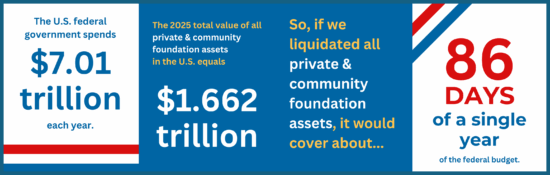
Johnson Center research (Williams, 2025) found that the nonprofit sector cannot replace the government’s role in providing basic services or promoting the nation’s general welfare. In 2025, federal expenditures totaled $7.01 trillion, while total assets held by private and community foundations amounted to only $1.662 trillion. As nonprofits are asked to do more with less, we need to be cognizant of the challenges, unclear boundaries, and unrealistic expectations that are created when philanthropy begins substituting for, or flat-out supplanting, the traditional roles of government, as noted by Caldwell (2018) and again by Martin (2021).
Due to the volatility of government programs, funding, and support of nonprofits, the nonprofit sector has learned that if “it is committed to systems change to improve outcomes for the most people, [it] will have to engage with the systems — and the systems makers — themselves” (Martin, 2025) through advocacy and lobbying efforts.
We are already seeing evidence of increasing engagement. In April 2025, the “Unite in Advance” campaign launched with a public sign-on statement to support philanthropy’s freedom to give (Allen, Bhargavaand, & Palfrey). Then, nearly six months later, leaders of more than 100 philanthropies banded together to issue an open letter defending their freedom of speech after the White House called out progressive foundations (Daniels, 2025b).
The relaunch of the Congressional Philanthropy Caucus by Rep. Danny Davis (D-IL) and Rep. Blake Moore (R-UT) in early December 2025 offers a bit of optimism. According to the group’s announcement on Moore’s website (2025), the group aims to help Members of Congress understand the sector’s impact and to promote
policies that strengthen America’s communities and the philanthropic and charitable sectors by supporting and expanding tax incentives for charitable giving, protecting the ability of foundations, individuals, and businesses to give back, and advancing public-private partnerships that empower and drive local impact.
According to reporting from The Chronicle of Philanthropy, Moore and Davis have already helped secure key wins for the sector this year, including advancing the universal charitable deduction that went into effect over the summer of 2025 and helping to kill proposed changes to foundation excise taxes (Daniels, 2025a). That report also notes the importance of direct advocacy from the United Philanthropy Forum in the reformation of the Caucus (para. 6), evidence that the sector is continuing to see the value of directly engaging with lawmakers.
Today, philanthropy continues to grapple with changes in government programs, services, funding, and even which words are deemed acceptable to use when describing the work. As Amir Pasic and Eugene R. Tempel wrote in a 2023 issue of Philanthropy Matters, we cannot ignore how vulnerable philanthropy is to changes in how the government behaves because “a vibrant independent sector and a just government that protects rights and liberties are like mirror images of each other” (para. 12).
Government and philanthropy remain intricately connected and dependent on each other. But the events of 2025 raise a fundamental question: Are we entering an era where philanthropy must function despite government, rather than with it?


Abalo, T., & Williams, J. (2025, January 15). Tax “cliff” in 2025 could mean major change for philanthropy and nonprofits. 11 trends in philanthropy for 2025. Dorothy A. Johnson Center for Philanthropy at Grand Valley State University. https://johnsoncenter.org/blog/tax-cliff-in-2025-could-mean-major-change-for-philanthropy-and-nonprofits/
Allen, T., Bhargavaand B., Palfrey, J. (2025, April). “Unite in Advance” philanthropy coalition launches solidarity campaign. Nonprofit Quarterly. https://nonprofitquarterly.org/unite-in-advance-philanthropy-coalition-launches-solidarity-campaign/
Aprill, E. P. (2025, July 25). Misunderstanding national religious broadcasters. Tax Notes. https://www.taxnotes.com/featured-analysis/misunderstanding-national-religious-broadcasters/2025/07/24/7ss1m
Caldwell, K. (2018, January 1). Governments and Nonprofits: New Partnerships or Paradigm Shifts? 11 trends in philanthropy for 2018. Dorothy A. Johnson Center for Philanthropy at Grand Valley State University. https://johnsoncenter.org/blog/governments-and-nonprofits-new-partnerships-or-paradigm-shifts/
Caldwell, K., & Downey, M. (2018, January 1). How repealing the Johnson Amendment could change the game for nonprofits. 11 trends in philanthropy for 2018. Dorothy A. Johnson Center for Philanthropy at Grand Valley State University. https://johnsoncenter.org/blog/how-repealing-the-johnson-amendment-could-change-the-game-for-nonprofits/
Caldwell, K., & Murray‑Brown, D. (2019, April 9). For nonprofits, the tax landscape is far from settled. 11 trends in philanthropy for 2019. Dorothy A. Johnson Center for Philanthropy at Grand Valley State University. https://johnsoncenter.org/blog/for-nonprofits-the-tax-landscape-is-far-from-settled/
National Council of Nonprofits. (2025). Protecting the Johnson Amendment and nonprofit nonpartisanship. https://www.councilofnonprofits.org/trends-and-policy-issues/protecting-johnson-amendment-and-nonprofit-nonpartisanship
Daniels, D. (2025a). 100+ foundations stand united as White House goes on the attack. The Chronicle of Philanthropy. https://www.philanthropy.com/news/100-plus-foundations-stand-united-as-white-house-goes-on-the-attack/
Daniels, D. (2025b). New philanthropy caucus ensures funders have friends on the Hill. The Chronicle of Philanthropy. https://www.philanthropy.com/news/new-philanthropy-caucus-ensures-funders-have-friends-on-the-hill/
Hauser, L., & Duniway, S. (2025, July 21). Understanding the proposed IRS settlement regarding the Johnson Amendment and churches’ political speech rights. Lathrop GPM. https://www.lathropgpm.com/insights/understanding-the-proposed-irs-settlement-regarding-the-johnson-amendment-and-churches-political-speech-rights/
Leddy, M. (2025, August 6). Nonprofits oppose new IRS stance on church political activities. Thomson Reuters Tax & Accounting News. https://tax.thomsonreuters.com/news/nonprofits-oppose-new-irs-stance-on-church-political-activities/
Martin, T. (2021, January 12). Philanthropy and government play increasingly overlapping roles in the public sphere. 11 trends in philanthropy for 2021. Dorothy A. Johnson Center for Philanthropy at Grand Valley State University. https://johnsoncenter.org/blog/philanthropy-and-government-play-increasingly-overlapping-roles-in-the-public-sphere/
Martin, T. (2025, January 15). Four key factors are driving a surge in nonprofit lobbying activities. 11 trends in philanthropy for 2025. Dorothy A. Johnson Center for Philanthropy at Grand Valley State University. https://johnsoncenter.org/blog/four-key-factors-are-driving-a-surge-in-nonprofit-lobbying-activities/
Moore, B. (2025, December). Congressman Blake Moore launches the bipartisan Philanthropy Caucus to increase charitable giving in local communities [Press release]. U.S. House of Representatives. https://blakemoore.house.gov/media/press-releases/congressman-blake-moore-launches-the-bipartisan-philanthropy-caucus-to-increase-charitable-giving-in-local-communities
National Religious Broadcasters, Sand Springs Church, First Baptist Church Waskom, & Intercessors for America v. Werfel, Complaint for Declaratory Relief, No. 6:24‑cv‑00311 (E.D. Tex. Aug. 28, 2024). https://nrbwebstorage.blob.core.windows.net/nrbwebserver/Website%20Docs/2024-08-28%20-%20complaint.pdf
Pasic, A., & Tempel, E. R. (2023, August). Philanthropy matters [Newsletter issue]. Indiana University Lilly Family School of Philanthropy. https://philanthropy.indianapolis.iu.edu/news-events/news/newsletter/philanthropy-matters/2023-issues/aug-2023.html
Tomasko, L., Martin, H., Fallon, K., Kim, M., Faulk, L., & Boris, E. (2025, October 7). How government funding disruptions affected nonprofits in early 2025. Urban Institute. https://www.urban.org/research/publication/how-government-funding-disruptions-affected-nonprofits-early-2025
Urban Institute. (n.d.). National survey of nonprofit trends and impacts. https://www.urban.org/nptrends/national-survey-nonprofit-trends-impacts
Wessel, D. (2025, November 14). What is a government shutdown and why are we likely to have another one? Brookings Institution. https://www.brookings.edu/articles/what-is-a-government-shutdown-and-why-are-we-likely-to-have-another-one/
Williams, J. (2025, March 27). Nonprofits and government revenue: Understanding a complex relationship. Dorothy A. Johnson Center for Philanthropy at Grand Valley State University. https://johnsoncenter.org/blog/nonprofits-and-government-revenue-understanding-a-complex-relationship/