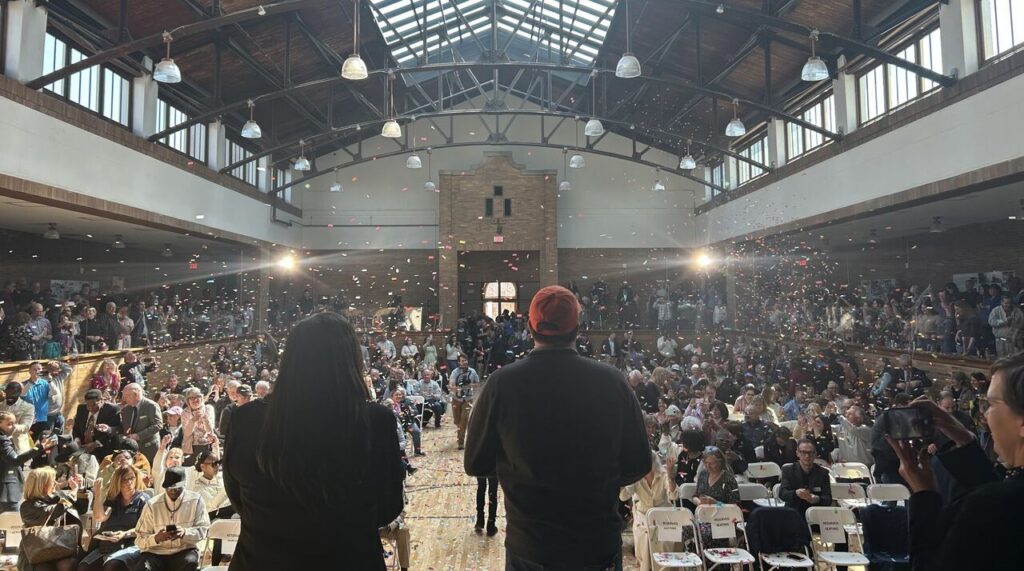
The most highly institutionalized manifestation of community philanthropy — the community foundation — originated in the U.S. Its global spread speaks to the universality of generosity, the deep attachment people have to place and community, and the adaptability of the organizational form.
Yet the model’s evolution across diverse contexts has sparked an ongoing discussion of what it means to be a community foundation at all: a replicable institutional model, or a values-driven civic practice responsive to dramatically different social realities. As the concept is adopted and adapted in more countries each year, what are its essential characteristics — and has it remained a field focused on technical excellence and institutional replication, or become a movement animated by a shared moral commitment to social justice, equity, and democratic participation?
Those questions had already been posed — with urgency — from within the American field itself. In 2005, the Monitor Institute’s landmark report, On the Brink of New Promise, surveyed more than 300 philanthropic leaders and reached a stark conclusion: U.S. community foundations had drifted. A generation of competition with commercial philanthropic vehicles had led the field to internalize the wrong measure of success. As Bernholz, Fulton, and Kasper (2005) put it, asset size — a proxy measure borrowed from the commercial sector — had “become a measure of meaning for most community foundations” (p. 8). The result was a field looking inward at operational mechanics rather than outward at civic purpose.
“A generation of competition with commercial philanthropic vehicles had led the field to internalize the wrong measure of success. … The result was a field looking inward at operational mechanics rather than outward at civic purpose.”
The spread of community foundations beyond North America was never a simple act of export. What began as the diffusion of an American institutional form quickly became something more complex: an encounter between a specific philanthropic model and the vastly different political, cultural, and economic realities of societies across Europe, Africa, Latin America, and Asia. In many of these contexts, the fall of communist and authoritarian regimes at the end of the twentieth century had unleashed a flourishing of civil society, while posing an urgent question: how could this emerging sector sustain itself with local rather than international resources? Community foundations, adapted and reinvented for each context, became one important answer. In the process, the very concept of the community foundation was transformed.
Today, the global community foundation field — and increasingly, movement — is no longer simply derivative of its American origins. It is a source of innovation in its own right.
The first community foundation outside the U.S. was established not in Europe, but next door: the Winnipeg Foundation in Canada was founded in 1921 by a local banker who had learned of the Cleveland experiment and made a substantial personal gift to launch it (Harrow et al., 2016). Notwithstanding the old characterization of community foundations as “poor cousins” in the family of philanthropic organizations (Hodgson & Knight, 2010), Canada’s sector has grown steadily, and today Community Foundations of Canada (n.d.) counts more than 200 members, collectively representing one of the country’s largest philanthropic resources.
Beyond North America, the United Kingdom established its first community foundation in 1976, and Australia followed in 1983. But it was the collapse of communism in 1989 and the subsequent democratic transitions in Central and Eastern Europe that opened the most consequential chapter in the global history of community foundations (Walkenhorst, 2021).
In these newly democratic societies, civil society organizations emerged rapidly but faced a fundamental sustainability problem: decades of authoritarian rule had suppressed both philanthropic traditions and the habit of voluntary association. External funders led by the Charles Stewart Mott Foundation, the Ford Foundation, and USAID recognized that community foundations could serve a dual purpose: building local philanthropic capacity while modeling the civic participation and transparent governance that nascent democracies required (C.S. Mott Foundation, 2001).
As the Mott Foundation’s two decades of field experience made clear, the concept had proven its versatility across vastly different tax structures, laws, and cultures, but only truly took root when shaped by local values, traditions, and needs rather than transplanted wholesale from the American context (C.S. Mott Foundation, 2001). The first community foundation in continental Europe was established in Banská Bystrica, Slovakia, in 1994 (Sacks, 2005). In Russia, the Togliatti Community Foundation, registered in 1998, became the model for a countrywide movement encompassing more than 40 foundations (Walkenhorst, 2021). In South Africa, the Uthungulu Community Foundation, established in 1997, became the first on the African continent, serving as a regional model and resource. Mexico remains Latin America’s leader in community foundation development, a sector that took root in the late 1980s through civic-minded business leadership and grew rapidly in the 1990s with international support (Berger et al., 2009).
“[T]he concept [of community foundations] had proven its versatility across vastly different tax structures, laws, and cultures, but only truly took root when shaped by local values, traditions, and needs rather than transplanted wholesale from the American context.”
Harrow, Jung, and Phillips (2016) identify an important tension in this process: while major private foundations served as essential strategic partners in seeding community foundations globally, that dependence on external — and often foreign — philanthropic capital created contradictory pressures. Foundations claiming to represent local self-determination while relying on international funders found themselves caught between civic aspiration and institutional dependency, a tension that would deepen as the field matured.
By the mid-2000s, a significant conceptual shift was underway. Practitioners and researchers began arguing that community philanthropy was not simply a matter of institutional form, but a broader values-based practice grounded in trust, participation, and local ownership (Hodgson, 2020). As Pinho (2014) argues, community philanthropy represents the missing link between local communities and international development, an approach that centers local knowledge and ownership rather than externally driven agendas. This reframing had profound implications.
The endowment-driven, grantmaking-centered model promoted globally by U.S.-based funders was only one possible expression of community philanthropy, and not always the most appropriate one. In many contexts outside North America, large donors were scarce, favorable tax structures did not exist, and the concept of “philanthropy” carried colonial or elite associations, making it politically fraught. Community foundations in these environments developed innovative strategies, including mixed portfolios combining small business revenues, government partnerships, and mass public fundraising; peer-to-peer giving campaigns; and community investment funds (Feurt & Sacks, 2000; McCarthy & Leopold, 2021).
On the Brink of New Promise crystallized the emerging critique: the previous era had forced community foundations to “improve themselves operationally,” but the era ahead would challenge them to “define and distinguish themselves strategically” (Bernholz et al., 2005, p. 9). That meant letting go of asset accumulation as the primary definition of success and embracing instead “strategic positions on challenging issues, cross-sector solutions, and a relentless commitment to the betterment of communities” (Bernholz et al., 2005).
By 2016, the Global Summit convened by the Global Fund for Community Foundations in Johannesburg gave institutional form to this orientation through the #ShiftThePower campaign, which called for a fundamental rebalancing of philanthropic authority from international agencies and donor-controlled institutions toward local people, organizations, and communities (Hodgson, 2020).
This reorientation represented more than a rhetorical repositioning. It reflected a growing conviction, grounded in field experience across Africa, Latin America, and Eastern Europe, that externally driven philanthropy, however well-intentioned, often reproduced the dependency relationships it claimed to address. As Hodgson (2020) argues, genuine community philanthropy disrupts and democratizes development by treating local populations not as recipients of aid but as co-investors in their own futures, whose knowledge, networks, and civic energy are the primary assets in any community’s philanthropic ecosystem.
The decade from 2015 to 2025 has been one of both deepening maturity and severe stress-testing. Globally, community foundations have faced economic instability, democratic backsliding, pandemic disruption, and the persistent challenge of achieving financial sustainability without surrendering civic identity to donor preferences.
The responses have been instructive.
Research by Wu (2021, 2024) has shown that the most effective community foundations share an orientation toward community leadership as a multidimensional practice — convening, knowledge-building, supporting policy engagement, capacity-building, and cross-sector partnering — and align their organizational structures to support that practice rather than subordinating it to asset accumulation. While Wu’s empirical work focuses primarily on U.S. foundations, its framework has resonance across contexts where foundations are navigating the same tension between donor service and civic purpose.
Perhaps the most significant structural development of this period has been the growth of cross-border networks that are building solidarity and generating knowledge among community foundations on a regional basis, largely independent of U.S. leadership.
Together, these networks mark a new phase: the global field has developed the infrastructure to generate and share knowledge across borders, nurturing and advancing the movement on its own terms.
The community foundation concept was born in Cleveland in 1914, a specific time and place far removed from the hundreds of communities that now claim foundations of their own. However, the essential values at its heart have proven universal. Neighbors caring for neighbors, generosity directed toward shared civic life, and the conviction that communities hold the knowledge and resources to address their own needs: these impulses have found a wide range of manifestations and adaptations around the world, offering important insights to the nation from which the institution first arose.
For U.S. community foundations grappling with questions of legitimacy, donor dominance, and civic purpose, the global experience offers three concrete lessons.
First, the most vibrant global community foundations demonstrate the value of thinking in terms of philanthropic culture and ecosystem rather than endowment size, building civic trust and creating conditions in which giving becomes a sustained community practice.
Second, community leadership is a practiced discipline that global foundations have pursued under conditions of authoritarianism, economic collapse, and open warfare, confirming that mobilizing resources means far more than fundraising and grantmaking. Social capital, local knowledge, and political courage have proven to be equally essential tools.
Third, the most dynamic global foundations make it clear that institutions need not wait for favorable legal frameworks or political stability to serve their communities with integrity. This lesson is particularly relevant for U.S. foundations working in under-resourced rural areas, disadvantaged communities, and places where civic infrastructure has eroded.
“[T]he most dynamic global foundations make it clear that institutions need not wait for favorable legal frameworks or political stability to serve their communities with integrity. This lesson is particularly relevant for U.S. foundations working in under-resourced rural areas, disadvantaged communities, and places where civic infrastructure has eroded.”
In return, the global field has much to gain from more than 110 years of U.S. community foundation experience, which spans large urban centers and rural counties, periods of economic boom and recession, and successive waves of institutional innovation. American community foundations have accumulated hard-won knowledge in building local philanthropic ecosystems, sustaining peer-learning networks, and developing field infrastructure that helps community foundations survive and grow. The challenge of moving from dependence on international funders toward locally generated resources remains acute for community foundations across the Global South and in post-transition societies, and U.S. foundations can serve as genuine partners in that effort.
The opportunity is to develop something genuinely generative: a global conversation among peers, each with something to teach and something to learn, united by a shared commitment to philanthropy as a civic practice rooted in the communities it serves.
Annauma Community Foundation. (n.d.-a). Our story. https://www.annauma.ca/our-story
Annauma Community Foundation. (n.d.-b). Consensus granting guide.
Azai Consultores. (2025). Informe de la Comunidad Iberoamericana de Aprendizaje en Filantropía Comunitaria (CIAF). https://www.azai.co/wp-content/uploads/2020/09/Informe-Desarrollo-Sostenible_Azai.pdf
Bentz, O. (2025, March). Finding light in darkness: The role of Ukraine’s community foundations in a time of war. https://globalfundcommunityfoundations.org/wp-content/uploads/2025/03/FindingLightInDarkness.pdf
Berger, R., Bermúdez, D., Carrillo Collard, P., & Tapia Álvarez, M. (2009, March). Mexico community foundations: A comprehensive profile. Teamworks/Alternativas y Capacidades. https://search.issuelab.org/resources/10274/10274.pdf
Bernholz, L., Fulton, K., & Kasper, G. (2005). On the brink of new promise: The future of U.S. community foundations. Blueprint Research & Design and Monitor Institute. https://www2.deloitte.com/content/dam/Deloitte/us/Documents/monitor-institute/us-monitor-institute-on-the-brink-of-new-promise.pdf
Community Foundations of Canada. (n.d.). Find a community foundation. https://communityfoundations.ca/find-a-community-foundation-map/
Connecting Communities in the Americas. (n.d.). About CCA. https://cc-americas.org/about
C.S. Mott Foundation. (2001). Sowing the seeds of local philanthropy: Two decades in the field of community foundations. https://www.mott.org/wp-content/uploads/2016/05/CSMFPublication19.pdf
European Community Foundation Initiative. (n.d.). Community foundations in Europe.https://communityfoundations.eu/community-foundations-in-europe/
Feurt, S. L., & Sacks, E. W. (2000). An international perspective on the history, development and characteristics of community foundations. In P. Walkenhorst (Ed.), Building philanthropic and social capital: The work of community foundations (pp. 15–39). Bertelsmann Foundation.
Harrow, J., Jung, T., & Phillips, S. D. (2016). Community foundations: Agility in the duality of foundation and community. In T. Jung, S. D. Phillips, & J. Harrow (Eds.), The Routledge companion to philanthropy (pp. 308–321). Routledge.
Hodgson, J. (2020). Disrupting and democratising development: Community philanthropy as theory and practice. Gender & Development, 28(1), 99–116. https://doi.org/10.1080/13552074.2020.1717214
Hodgson, J., & Knight, B. (2010). More than the poor cousin? The emergence of community foundations as a new development paradigm. Global Fund for Community Foundations. https://globalfundcommunityfoundations.org/wp-content/uploads/2011/11/morethanthepoorcousin.pdf
McCarthy, K. D., & Leopold, B. L. (2021). The CUNY International Fellows Program and community foundations: Learnings from the field. Center on Philanthropy and Civil Society at The CUNY Graduate Center. https://www.gc.cuny.edu/sites/default/files/2024-09/CUNY-Intl-Fellows-Program-Community-Foundations-Learnings-from-the-Field_upd092524.pdf
Pinho, A. P. B. (2014). Community philanthropy: The missing link between local communities and international development. Center on Philanthropy and Civil Society at The CUNY Graduate Center. https://www.gc.cuny.edu/sites/default/files/2021-05/AnaBorgesPinho_CommunityPhilanthropy_TheMissingLink.pdf
Pîrţoc, D., Bălan, E., Popeea, L., Jac, M., Berceanu, D., & Sasu, R. (2026, February 23). Romania’s philanthropy: Rebuilding a philanthropic culture after rupture. Philea. https://philea.eu/opinions/romanias-philanthropy-rebuilding-a-philanthropic-culture-after-rupture/
Sacks, E. W. (2000). The growth of community foundations around the world: An examination of the vitality of the community foundation movement. Council on Foundations. https://www.issuelab.org/resources/13803/13803.pdf
Sacks, E. W. (2005). International connections: Resources that support the growth and development of community foundations globally. Worldwide Initiatives for Grantmaker Support (WINGS). https://core.ac.uk/download/71352333.pdf
Walkenhorst, P. (2021). Foundations, community. In R. A. List, H. K. Anheier, & S. Toepler (Eds.), International encyclopedia of civil society. Springer. https://doi.org/10.1007/978-3-319-99675-2_38-1
Wu, V. C. S. (2021). Community leadership as multi-dimensional capacities: A conceptual framework and preliminary findings for community foundations. Nonprofit Management and Leadership, 32(1), 29–53. https://doi.org/10.1002/nml.21467
Wu, V. C. S. (2024). Community leadership and donor-advised funds: Navigating logics of donor services and community leadership in community foundations. Nonprofit and Voluntary Sector Quarterly, 54(4), 773–803. https://doi.org/10.1177/08997640241279057





© 2026 Dorothy A. Johnson Center for Philanthropy. All rights reserved.
201 Front Ave SW, Suite 200, Grand Rapids, Michigan 49504 | (616) 331-7585 | jcp@gvsu.edu