Effective community philanthropy requires a solid understanding of the specific needs and local circumstances of a community. However, many funders and philanthropists still rely on technical expertise and top-down leadership. As highlighted in this special issue of The Foundation Review, listening to communities is crucial for effective philanthropy. Yet this is easier said than done.
While listening can enhance program effectiveness and shift power towards communities, it can also leave gaps between intention and action. Further, not all listening practices are equally beneficial. Hence, when organizations that practice community philanthropy, such as community foundations, misunderstand local realities, even well-intentioned initiatives can produce unintended consequences, such as reinforcing inequalities, overlooking important voices, or using scarce resources inefficiently.
Building on our research on community foundations in Spain (published in the Journal of Business Venturing), we explain the idea of civic listening as a strategic ability that can contribute to effective community philanthropy. With “civic listening,” we refer to the ability to generate awareness of local challenges and opportunities by placing the perspectives of community stakeholders at the center. Importantly, we found that civic listening is not just about gathering information.
Under the right conditions, community foundations can help create a shared awareness among local actors — including nonprofits, businesses, public institutions, and residents — about both the problems communities face and the solutions worth pursuing. This collective awareness matters because it enables more coordinated and cross-sector responses to community challenges, strengthens community buy-in and participation, and can even enhance resilience during systemic shocks such as natural disasters or economic crises.
This can be accomplished through four interrelated civic listening practices: seeking awareness, attracting awareness, co-creating awareness, and adapting to local conditions. Below, we illustrate these ideas with examples from community foundations in Spain.
As in many countries of the Global North, community foundations are the prevalent form of community philanthropy in Spain. Currently, there are 12 community foundations in the country, many of them along the Mediterranean coastline. Most of these community foundations were founded in recent years, catalyzed by a community foundation development program launched by the Spanish Association of Foundations in collaboration with the Charles Stewart Mott Foundation, alongside two European Philanthropic foundations.
Unlike the U.S., where philanthropy is deeply ingrained in the culture, philanthropic organizations in Spain are often viewed with a degree of suspicion. Accordingly, community foundations in Spain raise funds at a much lower scale and instead put a greater emphasis on community leadership. It is in this context that we developed the concept of civic listening.
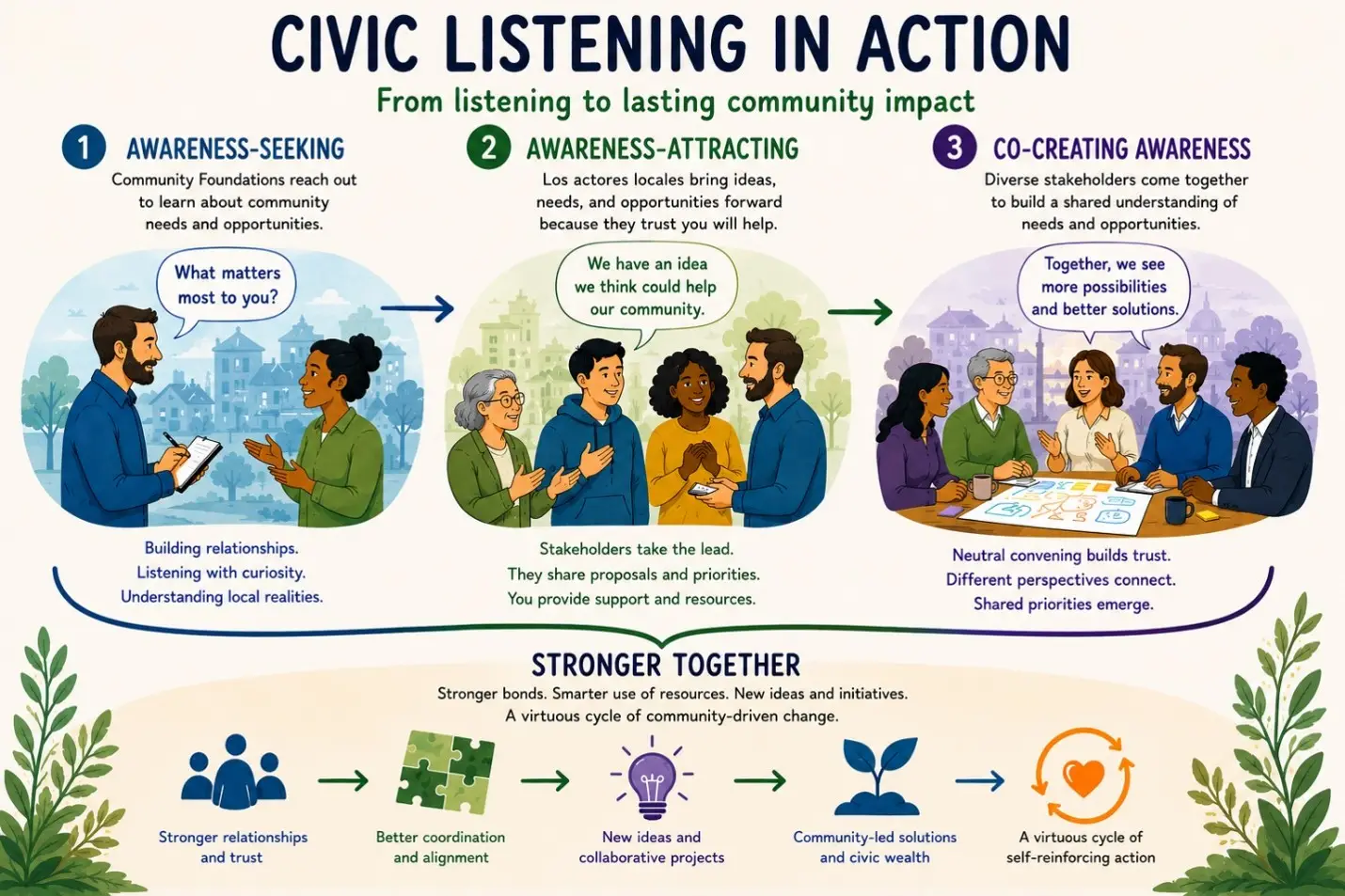
A key practice of effective community philanthropy is awareness seeking: the intentional effort to understand the needs, priorities, and opportunities that matter most to local communities. Rather than relying solely on reports, data, or their own assumptions, community foundations actively reach out to residents, nonprofits, civic leaders, and other local stakeholders to learn what is happening on the ground.
This awareness-seeking is made possible by the strong relationships and local connections that community foundations cultivate over time. By being deeply engaged in their communities, they become part of the networks of trust, collaboration, and shared understanding that connect local actors.
“By being deeply engaged in their communities, [the community foundations] become part of the networks of trust, collaboration, and shared understanding that connect local actors.”
For instance, we studied one foundation that works with young people in an underprivileged neighborhood of a large Catalan city. Members of the foundation’s team regularly spent time with local families while their children played soccer on weekends. Through these informal interactions, they gained a deeper understanding of what interested and motivated the children, enabling the foundation to expand and better tailor its extracurricular programs to their interests.
These relationships create opportunities for ongoing dialogue and help community foundations stay informed about emerging challenges, community aspirations, and promising opportunities for action.
Community foundations engage in awareness-seeking through both formal and informal channels. Formally, many rely on boards that are intentionally composed of individuals with deep ties to different parts of the community. For instance, another foundation we worked with in a rural area in Catalonia intentionally built its board of local leaders, including educators, business leaders, and journalists.
Because board members are closely connected to local organizations, residents, and institutions, board discussions become an important source of information about emerging needs and opportunities.
Informally, awareness-seeking often occurs through everyday interactions. Staff who live and spend time in the community gain valuable insights through conversations with residents at local gathering places, community events, or simply in the course of daily life. These informal encounters help surface concerns and ideas that might otherwise go unnoticed.
A second practice is awareness-attracting. Whereas awareness-seeking involves community foundations actively reaching out to learn about local needs and opportunities, awareness-attracting occurs when community members, nonprofits, and other local stakeholders bring those needs and opportunities directly to the community foundation.
This becomes possible when community foundations develop a reputation for supporting the work of others. Over time, local stakeholders come to see them as trusted partners who can provide resources, connections, and other forms of support. As a result, residents and organizations proactively approach them with ideas, concerns, and proposals for strengthening their communities. For instance, the director of one of the foundations we worked with stated: “We don’t need to have a meeting to invite businesspeople so they can tell us their ideas […], because they come to us […] and say: ‘Hey, you have to help us, look at what we’ve detected.’”
“Awareness-attracting … gives considerable agency to local actors and depends on their willingness and ability to participate in civic life.”
In this approach, community foundations are not the primary source of ideas or solutions. Instead, local stakeholders play a leading role in identifying priorities and shaping initiatives. Community foundations act as enablers, helping community-driven efforts gain the support they need to succeed. Awareness-attracting, therefore, gives considerable agency to local actors and depends on their willingness and ability to participate in civic life.
In our research, community foundations reported that residents, volunteers, nonprofits, businesses, and public agencies regularly approached them with proposals, concerns, and emerging challenges. For example, one foundation in the province of Valencia was approached by the local government to convene farmers, community groups, and residents to develop a coordinated response to climate-related disasters. This need became apparent after some areas of the province had been devastated by severe flooding. Accordingly, the foundation launched a working group involving the city council, citizens, irrigators, and farmers to develop an emergency plan for climate-change-induced natural disasters.
A third practice is co-creating awareness. Whereas awareness-seeking and awareness-attracting focus on understanding needs and opportunities from individual stakeholders, co-creating awareness brings diverse stakeholders together to develop a shared understanding of the community’s priorities.
Rather than advancing their own agenda, community foundations work to create spaces where residents, nonprofits, businesses, and public agencies can come together around issues of shared concern. By maintaining this neutrality, they encourage participation from groups that might not otherwise engage with one another and help foster open and constructive dialogue.
For example, the director of a foundation operating in a neighborhood of Barcelona explained that the foundation creates safe spaces for meetings that allow diverse actors, such as neighbors, town hall clerks, and small business owners, to engage in a conversation around the challenges the neighborhood faces. Without these safe spaces, these people “would hardly speak and fight”; but thanks to the meetings organized by the foundation, they have an opportunity to express and share their perspectives and experiences. In this way, awareness becomes something that is co-created rather than gathered from individual actors. The result is a stronger shared understanding of community priorities and a greater capacity for collective action.
“[A]wareness becomes something that is co-created rather than gathered from individual actors. The result is a stronger shared understanding of community priorities and a greater capacity for collective action.”
In practice, co-creating awareness often involves creating spaces where people who would not normally interact can come together to discuss shared challenges. Several community foundations in our study convened residents, nonprofits, businesses, and public agencies to exchange perspectives and jointly explore solutions. As illustrated above, these conversations helped participants move beyond their individual concerns and develop a broader understanding of community priorities.
Notably, community foundations remain committed to a collaborative approach, including public authorities, even as political polarization tends to increase in Spain. For instance, one of the foundations we worked with in Valencia continues seeking to build bridges between associations, businesses, and public administration, even as the far-right regional government cuts funding and support for third-sector organizations.
Community foundations also contributed by sharing their deep knowledge of local organizations, relationships, and community dynamics. This wider perspective helped stakeholders identify connections, avoid potential pitfalls, and align their efforts around a more coherent vision for the community’s future.
Effective civic listening requires community foundations to recognize and work with the assets that already exist within their communities. While communities possess many different forms of capital, our research focused on social capital — the relationships, networks, trust, and civic participation that connect people and organizations.
The three civic listening practices described above do not require the same level of social capital. Awareness-seeking can be effective even in communities with relatively limited civic infrastructure. Even where there are only a handful of active organizations or community leaders, community foundations can reach out, build relationships, and begin learning about local needs and opportunities.
Awareness-attracting, however, depends on a stronger foundation of civic participation. For community members and organizations to proactively share ideas and proposals, they must be willing and able to engage in community life. Similarly, co-creating awareness requires an even more developed network of organizations, relationships, and collaborative activity. Bringing stakeholders together to build a shared understanding is only possible when there is a diverse group of actors ready to participate in those conversations.
Taken together, awareness-seeking, awareness-attracting, and co-creating awareness illustrate that civic listening is not a single activity but a set of complementary practices that build on the available assets of a given community. Community foundations can actively seek out community perspectives, create conditions that encourage stakeholders to share their own ideas and priorities, and convene diverse actors to develop a shared understanding of local challenges and opportunities.
“[T]hese approaches help build trust, strengthen relationships, and foster new collaborations. The result is a community that becomes increasingly capable of coordinating its own efforts, generating its own solutions, and sustaining collective action over time.”
In particular, the latter two practices place considerable agency in the hands of community members and organizations, empowering them not only to identify needs but also to shape responses. When practiced together, these approaches help build trust, strengthen relationships, and foster new collaborations. The result is a community that becomes increasingly capable of coordinating its own efforts, generating its own solutions, and sustaining collective action over time.
One of the key lessons is that creating social impact requires more than technical expertise or top-down leadership. Instead, philanthropists must also create conditions for trust, participation, and open dialogue to emerge organically over time. Paradoxically, our research suggests that philanthropists often become trusted leaders not by trying to impose their ideas (as in, not by being the experts themselves), but by empowering local stakeholders, sharing ownership, and demonstrating a genuine commitment to the long-term well-being of the place and the people they serve. In so doing, philanthropists bestow agency on the communities they aim to serve, which is paramount for successful community philanthropy.
A 2025 issue of The Foundation Review explores this topic in depth, describing what funder listening is (and is not) and what happens when it is practiced with a clear purpose: shifting power to communities so they are partners in driving social change.