Across Latin America and the Caribbean, the funding landscape is shifting, and those shifts are not always favorable to philanthropy. Organizations are grappling with tough questions about long-term survival. People are wondering if traditional, donor-dependent models are sufficient to sustain meaningful work. But while headlines may focus on what’s lost, something more durable may be growing from the ground up.
Since the return to democracy in much of Latin America in the early 1990s, a growing number of place-based funders have stepped up. These place-based foundations — often called community or territorial foundations — are built through small, local contributions that grow over time into expansive, impactful systems. These community foundations support grassroots organizations that work to improve social and economic conditions. Over time, they can transform neighborhoods, restore local ecosystems, and strengthen governance through transparency and accountability. What begins as a localized effort can evolve into a broader movement, with networks of civil society organizations scaling up to drive sustainable development and create lasting improvements.
Building on existing practices of community solidarity, community foundations strategically raise funds from local and international sources to channel support to medium- and long-term community-led initiatives in their surrounding areas. This form of philanthropy is different from the ebbs and flows of bilateral international funding. It is homegrown, long-term, and connected to the residents it serves.
As practitioners in community-led development, we’ve spent years supporting community foundations across the region, helping them become vehicles for local aspirations and strengthening the skills communities need for democratic participation. Our work with Comunalia (Mexico’s national alliance of community foundations) and other regional networks has given us a front-row seat to this transformation.
More than 25 years after a mix of public and private foundations awarded the first grants to place-based organizations in Oaxaca, Mexico, we reflect on key lessons from this work. These insights offer valuable perspectives on how to amplify the impact of local philanthropy, embrace collaboration, and scale community-led initiatives to foster long-term growth and resilience throughout Latin America and the Caribbean.
We might think of “philanthropists” as people who donate significant money to make projects happen. That narrow definition can exclude organizational staff, participants, and other community members. It can also lead us to discount the generosity of Latin American and Caribbean communities because their contributions typically take other forms. When we fully acknowledge all the contributions local people make, it becomes clear that they are also philanthropists, acting on behalf of humanity.
Research on community philanthropy promoted by Arrecife, a Mexican network of community philanthropy organizations, shows that for every $1 invested by outside funders, communities contribute resources valued at $8 on average.

As another example, the Inter-American Foundation (IAF) awarded micro-scholarships for young people to pursue formal or vocational education. When the implementing organization quantified all the contributions necessary for a student to complete their education, they found that scholarship recipients and their families were covering costs such as food, housing, school supplies, and transportation. Community members raised money for additional scholarships and volunteered to serve on a supervisory committee. Participants recognized the extent of their investments — and therefore their own philanthropy — only after the organization quantified them.
“When local partners see themselves as co-investors rather than recipients, they engage differently. They build the muscle for long-term self-reliance.”
Making these contributions visible does more than credit communities for their generosity. It rebalances power in funding relationships. When local partners see themselves as co-investors rather than recipients, they engage differently. They build the muscle for long-term self-reliance.
When two devastating earthquakes struck Mexico in 2017, community foundations emerged as the first responders. Their deep knowledge of local needs allowed them to act swiftly and effectively, and the trust they had built over years of collaboration positioned them as reliable allies for grassroots organizations.
While national agencies or international humanitarian organizations may appear better equipped, their standardized approaches often lack both agility and the local knowledge needed to adjust to the specific relationships, geography, and people in the area. Additionally, large institutions can experience donor fatigue, which limits their responsiveness when time is of the essence.
In contrast, community foundations harness their deep local knowledge to address both urgent relief efforts and long-term recovery needs. Community foundations in Mexico, for example, mobilized $3.1 million in local investments — a figure that includes cash donations, the calculated value of all goods collected, and services mobilized — accounting for 77% of the total funding raised for earthquake response. These investments strengthened the local economy during a crisis and positioned the community for long-term growth and resilience.
Community foundations thrive through collaboration and the exchange of best practices with peers. By building strong partnerships with government and businesses, these foundations play a pivotal role in helping communities achieve their goals in areas such as housing, green spaces, job and education opportunities, and more.
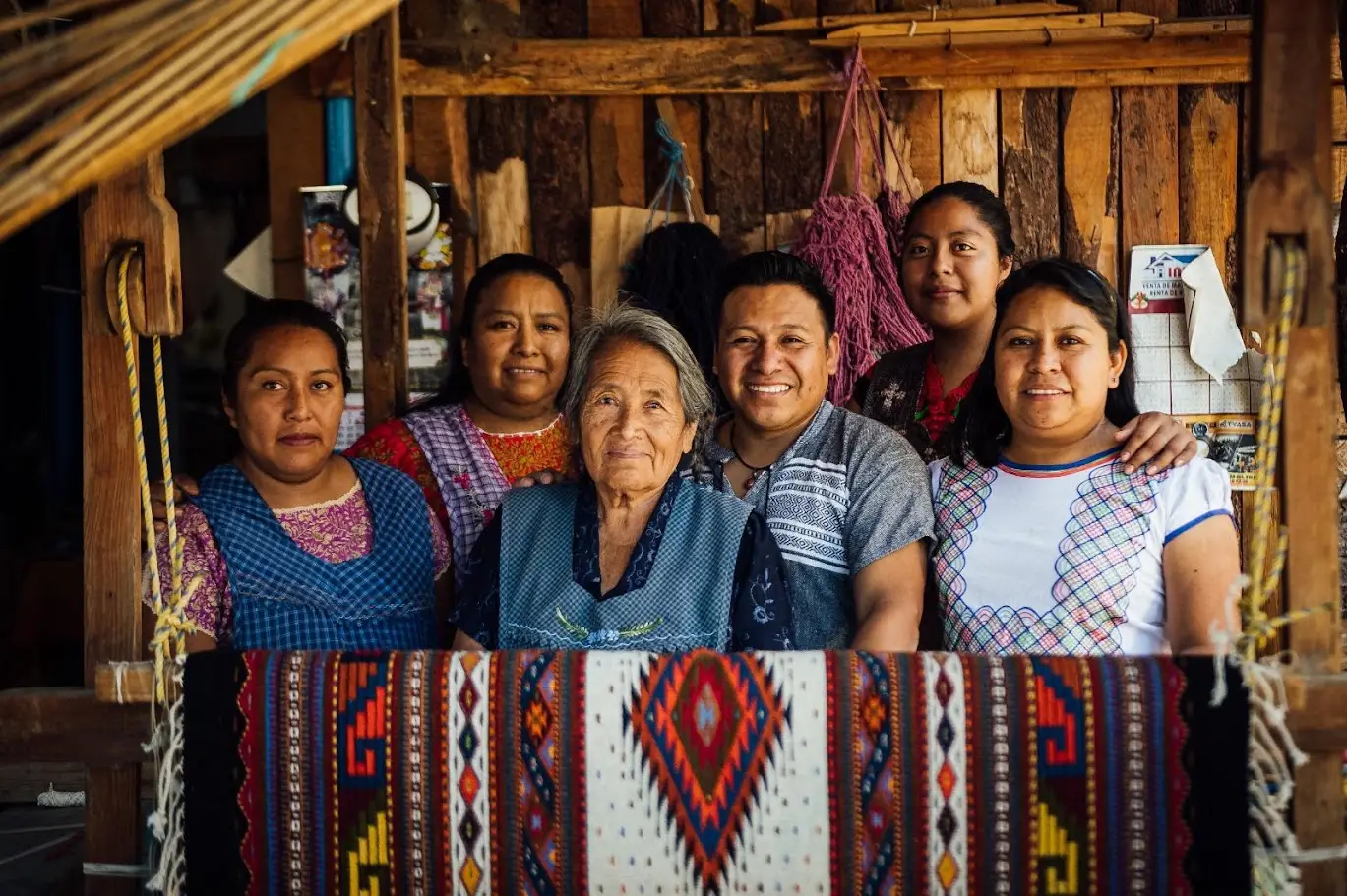
One of Latin America’s first community foundations was Fundación Comunitaria Oaxaca (FCO). The IAF and other international private foundations awarded FCO an early grant to leverage local and national Oaxacan resources. Through its first grant, FCO partnered with low-income communities in Oaxaca to support Zapotec weavers from the Central Valley in strengthening their pedal-loom weaving and natural-dye practices, while also mobilizing local resources to fund sustainable grassroots development. The focus was always on empowering local people and organizations to drive their own change — rather than simply providing top-down charity.
As more community foundations emerged across Mexico in the 2000s, they began collaborating, learning from each other, and identifying shared goals. This collective effort led to the creation of Comunalia in 2011. By connecting and coordinating community foundations’ efforts, Comunalia has helped scale community-led development by making it easier to replicate effective practices and pool resources.
During the COVID-19 pandemic, Comunalia launched two challenge funds to support its 17 members using a simple but powerful model: grants were awarded based on criteria such as technical viability, community ownership, matching funds, and demonstrable results. This model not only expanded support to 80 vulnerable communities but also transformed $700,000 in international funding from IAF and Fundación Coca-Cola into $5 million by leveraging local donations and in-kind contributions. Mexico’s network of community foundations demonstrated how small, localized actions — when linked together — can scale into powerful, resilient systems that sustain entire communities over time.



Strong democracies rely on everyday people getting involved and helping their communities. Community foundations across Latin America are bringing people together to tackle local challenges. This insight is evident in the work of local philanthropic organizations like Fondo Región Colonia (FRC) and Redes da Maré.
FRC has become a cornerstone for regional development in Uruguay by conducting the first comprehensive assessment of civil society needs. This initiative not only guides FRC’s programs but also helps local governments and businesses allocate resources strategically. Leveraging its regional expertise and trust, FRC partnered with 20 local and national companies to align local organizations with corporate support. For instance, a forestry company supported the Chau Mercurio project to promote the safe disposal of mercury-based lighting, while the law firm Guyer & Regules provided pro bono services to help the Colonia Te Abraza group incorporate legally, enhancing its capacity to support vulnerable immigrants.
In Brazil’s Maré complex, Redes da Maré empowers grassroots initiatives through advocacy, citizen participation, and training. While Redes da Maré is a nongovernmental organization that relies mostly on external grants, in the last two years its leadership has established the Fundo Comunitário de Desenvolvimento da Maré to support on-the-ground organizations that improve the lives of Maré residents. Its resources are directed toward strengthening local organizations, supporting political advocacy initiatives, and financing strategic projects in education, health, environment, culture, and the right to public security.
Despite differing contexts, both FRC and Redes da Maré demonstrate how these organizations cultivate an engaged citizenry and connect residents to their local governments.
Local philanthropy has the potential to empower vulnerable communities by providing essential resources and opportunities, but overreliance on grants for re-granting can hinder the long-term self-sufficiency of community foundations. This approach risks fostering dependency on external funding rather than promoting sustainable empowerment.
Unlike community foundations in the U.S. and Canada, which often rely on endowments for financial stability, relying on grants has been less viable in Latin America and the Caribbean. To address this challenge, place-based organizations in the region are adopting innovative strategies to sustain their operations. By diversifying funding sources and generating income through their activities, they aim to ensure local groups thrive independently and avoid becoming mere intermediaries.
“[R]elying on grants has been less viable in Latin America and the Caribbean. To address this challenge, place-based organizations in the region are adopting innovative strategies to sustain their operations.”
As early as 1990, the business community in the northern state of Chihuahua, Mexico, requested that the state government approve a 10% increase in the payroll tax companies paid, to be used to create a trust fund for reconstruction efforts following severe flooding in the region. Four years later, the same group of business leaders established a similar fund aimed at long-term development, the Fundación del Empresariado Chihuahuense (FECHAC). FECHAC was tasked with managing the funds and awarding grants to civil society organizations and has successfully invested over $155 million in social programs to improve education, health, and human development.
Some community foundations are connected to private-sector philanthropic ventures, giving them an ongoing funding base. For example, Asociación Aldea Global, a coffee producer association in Nicaragua, spun off a sister grantmaking institution, Fundación Aldea, to make community grants from a portion of its coffee profits. This model enables a local coffee producer association to sustain social investments and offers a blueprint that can be adapted in other rural areas of the region. A variation of this model is underway in Costa Rica, where Fondo Comunitario Monteverde partners with the Coffee Tour Alliance, a group of four local coffee tour operators. For every coffee tour visitor, the alliance donates $1 to the fund, raising more than $230,000 since August 2020. These contributions help finance community development initiatives such as sustainable agriculture, environmental education, and infrastructure improvements.
When it comes to supporting communities, funding great initiatives is important, but it’s not enough on its own. Real impact often comes from what happens between the programs: the conversations, shared experiences, and learnings that take place when people come together.
Across Latin America, local philanthropic organizations are creating spaces for learning and exchange — both in person and online — where community leaders and organizations connect to share experiences, insights, and challenges. These gatherings, whether small peer visits or big annual meetings, help people share what’s working, avoid repeating mistakes, and develop new solutions. When groups face similar challenges, learning from each other can be one of the most powerful tools they have. Some of these cross-country networks include Connecting Communities in the Americas, CIAF, and RedColaborar.
“When groups face similar challenges, learning from each other can be one of the most powerful tools they have.”
These groups adapted ideas together, sharing templates, learning from each other’s missteps, and even using the same names and processes for their circles in different cities. That’s the kind of collective momentum that can turn a good idea into a movement.
These six lessons point toward a broader truth: the future of civil society in Latin America and the Caribbean won’t be built primarily by outside funders. It will be built by the communities themselves, supported by local institutions that understand their needs, share their stakes, and plan to be there for the long haul.
Community foundations aren’t a replacement for international funding or government investment. But they offer something those sources often cannot: continuity, accountability to local residents, and the patient work of strengthening democratic participation from the ground up.
For funders, the implication is clear: invest in local philanthropic infrastructure, not just individual projects. For policymakers: create enabling environments for community foundations to grow. And for community leaders already doing this work: know that you’re part of a growing movement — one that’s proving, across diverse contexts, that lasting change is rooted in local soil.
Thanks to Rebecca Nelson, communication specialist at the IAF, for her valuable contributions and edits in earlier drafts of this blog.