The nonprofit sector lacks a unified vision and shared language to articulate the full breadth of pathways available to nonprofits that are otherwise facing financial or operational crisis. This vacuum has allowed the “merge or close” dichotomy to dominate the conversation, ultimately limiting our sector’s creativity, collaboration, and hopefulness. In Part 1 of this series, we described nine options that nonprofits can leverage to keep their mission alive while evolving their organizational operations for greater efficiency and stability.
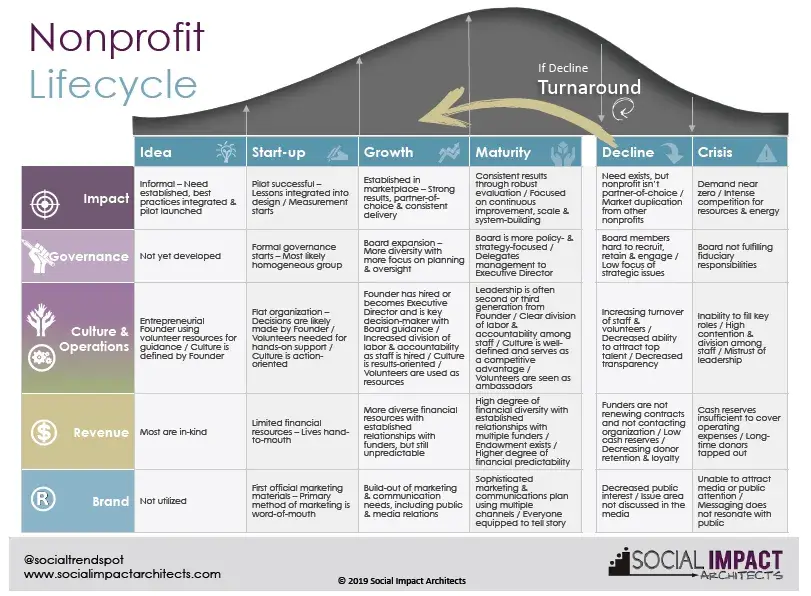
What does exist in our field is an influential and valuable model for understanding the evolution of a typical nonprofit: the Nonprofit Lifecycle Model, introduced by Dr. Susan Kenny Stevens in 2001. For more than two decades, this model has been a valuable tool for assessing an organization’s maturity and operational stage and for understanding what sorts of capacity supports, resources, and considerations are needed at each stage.
Importantly, Stevens’ model socialized the idea that nonprofit organizations experience identifiable stages of organizational development, and while the patterns and characteristics of those stages are recognizable, the model asserts that an organization’s movement through them isn’t necessarily predictable. Natural organizational development is not strictly linear from beginning to end. By naming and describing common stages, the model also gave practitioners a common language and actionable insights for operational decision-making.

As our investigation into alternatives to the “merge or close” dichotomy progressed, we revisited the Nonprofit Lifecycle Model to see how we might integrate our findings into it. Other organizations have taken a similar approach since the model was first introduced. Social Impact Architects, for instance, expanded the model to consider how the dimensions of Impact, Governance, Culture & Operations, Revenue, and Brand may take shape or require different levels of attention at each stage.
Another example: Move United, a nonprofit dedicated to advancing adaptive and equitable sports and recreation, explored the Nonprofit Lifecycle Model through the dimensions of Programs, Management, Governance, Financial Resources, and Administrative Systems.
Our adaptation of the Nonprofit Lifecycle Model takes a similar approach, but with an important shift in the visual layout. We wanted to emphasize that, from an organization’s inception and at every stage of its life, leadership and stakeholders should consider the value of, and opportunities for, adapting, restructuring, and exiting — strategies we laid out in Part 1. Developing a wheel-shaped visualization, with its ability to imply connection points between concentric layers, suited our purposes better than the existing flat model.
To support nonprofit leaders, board members, and communities in initiating and walking through these conversations, we have developed the new diagram, Nonprofit Lifecycle: Aligning Model to Mission, that builds on Stevens’ original work by combining the core stages of organizational development with a visual system for prompting critical questions and making strategic shifts to operational models. Our diagram converts the model’s original flat layout into a wheel format, shifts the initial Idea stage to the center of the model, and creates concentric layers spanning out from that center, labeled with our three categories for Strategic Options: Adapting, Restructuring, and Exiting.
In “Grounded in Purpose: What Philanthropy Can Learn from Psychology,” Kallie Bauer, Tory Martin, and Emily Brenner explore how existentialist theory can offer philanthropic organizations a set of concepts and exercises to reground purpose, programs, and decision-making in the mission. In most cases, the questions that existentialism prompts — “Who am I? What is my purpose? Am I part of a larger project?” — are the same questions that founders wrestle with during Stevens’ Idea stage. This is where it all begins, the moment of inspiration and catalyzation that opens the door to everything that comes after it.
Put another way, the Idea is the mission before it was ever put into an official statement; it is the reason the organization exists at all. By placing it at the center of our visual, then, we intend it as a prompt to all organizations to revisit their mission — their purpose — at each stage of their development, crisis or no crisis.
Our main goal in converting the flat model to a wheel format is to visually demonstrate that leaders, boards, and communities have access to different Strategic Options at all stages of development and can combine one or more strategies simultaneously. Every stage on the rim of this wheel sits on top of three concentric layers of possibility. Users of the diagram can read inward for efficiencies that are narrower in scale, and outward for deeper structural moves; a single glance shows the full menu of strategies available at any point.
Assessing these options against an organization’s specific circumstances requires a clear-eyed understanding of where that organization is on the continuum of mission fulfillment. It also requires a continuous conversation about the opportunities that innovation and partnership present.
The challenge of the wheel format is that it naturally implies a certain inevitability to an organization’s pathway through each stage and back around to the beginning. In its original conception, the Nonprofit Lifecycle Model uses an arrow to direct nonprofits facing crisis to go back to the Start-Up/Growth stage and start over. By exploring the Terminal/Closure stage in greater detail, and by including “Exiting: Strategic Closure” in the array of Strategic Options we offered in Part 1, we hope to lend more weight and awareness to the idea that closure can be a legitimate and appropriate response.
“[I]n each stage, leaders should consider how adapting, restructuring, or exiting might support the mission’s ongoing agility, creativity, sustainability, and impact — and not only how changes might affect the organization itself or the individual leader’s position.”
The key is this: in each stage, leaders should consider how adapting, restructuring, or exiting might support the mission’s ongoing agility, creativity, sustainability, and impact — and not only how changes might affect the organization itself or the individual leader’s position. Weighing and implementing each strategic option then involves asking important questions about capacity, resources, operating environment, and legal structures.
In our sector, organizational survival is often treated as an intrinsic good — funders reward persistence, boards see closure as a governance failure, leaders internalize it as personal defeat. The closure literature shows that this is largely a cultural problem, not an empirical one: organizations close for many reasons, including mission completion, environmental change, and deliberate strategic choice, rather than solely because of mismanagement or other crises. Plenty of examples exist outside our sector to demonstrate a different approach: tech start-ups in Silicon Valley, for instance, apply a very different social construct and cultural treatment to the concept of “failure” than the nonprofit sector currently does.
Research specifically on the dissolution of human services organizations found that ecological competition and resource scarcity, rather than internal dysfunction alone, drove exits. And in a 1990-2014 panel study using IRS Form 990 data, researchers found that the sector’s growth was largely driven by the formation of new nonprofits. They assert that policymakers and leaders should focus on reducing barriers to exit to manage growth and optimize sector resources. Consider that, between 2014 and 2026, the sector grew by nearly half a million organizations.
“Just as life, death, and renewal are natural parts of any living system, nonprofit exits should broadly be considered part of natural organizational ecology, rather than always a leadership failure.”
The binary of “survive or fail” — like “merge or close” — obscures the full strategic landscape and creates stigma where strategy should lead. Just as life, death, and renewal are natural parts of any living system, nonprofit exits should broadly be considered part of natural organizational ecology, rather than always a leadership failure. That distinction is important for practitioners, because it changes the conversation from blame to fit: Is the current legal entity still the best vehicle for the mission, or is another form better?
Still, the visualization of information and ideas is an imperfect art. We believe that our Nonprofit Lifecycle: Aligning Model to Mission better reflects what the literature shows and what realities we have faced in the past six years: organizations close, merge, and transform for many reasons, and those reasons are often rational responses to changing environments rather than signs of mismanagement or failure. The practical value of this reframing is not abstract. It gives nonprofit leaders the language to guide hard decisions, helps funders support transitions without stigma, and encourages the sector to preserve missions even when individual organizations cannot persist in their original form. In that sense, closure is not the opposite of mission continuity. Sometimes it is the mechanism that makes mission continuity possible.