In the face of persistent and compounding crises, soaring demands, and declining resources, a growing number of nonprofits are at risk of closure. According to recent research from the Center for Effective Philanthropy (CEP) (Grundhoefer et al., 2026), for example, 15% of nonprofits are considering “merging with another organization,” while 7% are considering “entering a fiscal sponsorship relationship.” Nearly half (46%) are concerned they may have no choice but to close or merge (Buteau et al., 2026).
“Choice” is an important word in the sector today. With so many forces shaping our work beyond our direct control, leaders and their stakeholders are struggling to feel agency over their missions and operational decisions. As a field, we are looking for ways to regain our sense of stability and direction, and seeking avenues to make decisions with confidence and adaptability.
As an applied research center, we at the Dorothy A. Johnson Center for Philanthropy (Johnson Center) have been casting a broad net to identify and consider research, theories, and frameworks that could support the sector’s effective decision-making and action today. Earlier this year, Kallie Bauer, Emily Brenner, and Tory Martin (2026) published “Grounded in Purpose: What Philanthropy Can Learn from Psychology,” offering existentialism and trauma theory as lenses through which the field can name its challenges and reconnect with core missions.
Once the mission is clear, the next series of questions for almost all organizations is operational. That is why we engaged in a research project to identify the evidence in the field that helps organizations facing financial crisis identify, assess, and choose the path forward that is right for them. What do we, as a field, know about these pathways? What are the implications for organizations, communities, and the nonprofit sector? And are nonprofits — and their funders, donors, and audiences — prepared to adapt, partner, and even exit effectively in an environment undergoing near-constant change?
“The question leaders should be asking is not, ‘How do we keep the organization alive?’ but, rather, ‘What is the best way to continue advancing our mission?’”
While our research revealed some critical gaps in the field’s knowledge and available tools, the literature is clear about one thing: the question leaders should be asking is not, “How do we keep the organization alive?” but, rather, “What is the best way to continue advancing our mission?” Nonprofits have more options available than they might realize.
Too often in our sector, nonprofits are presented with the limited narrative that merger and closure are the only two options when facing a financial cliff. In fact, the literature on mergers and the voices of leaders advocating for more mergers in the field made up the bulk of what we found. During the Great Recession (La Piana, 2010; Guggenheimer, 2012) and again during the COVID-19 pandemic (George & Stinebrickner-Kauffman, 2021; Gose, 2025a; Delaney & O’Leary, 2022), mergers were presented as the best and essentially only pathway for addressing severe funding challenges in the sector. As David LaPiana observed in the Stanford Social Innovation Review (SSIR) in 2010, “Mergers, the thinking goes, would reduce the intense competition for scarce funding. Consolidating organizations would also introduce economies of scale to the sector, increasing efficiency and improving effectiveness” (para. 2).
Faced with existential threats once again, many are now turning to this familiar option. At the 2025 Independent Sector National Summit, one session featured an expert panel discussing merger and acquisition (M&A) readiness, risks, and opportunities. In the news, former GuideStar CEO Jacob Harold published “Recombination as Rebirth” in SSIR, recounting his time overseeing the 2019 merger with the Foundation Center to form Candid. May 2026 reporting by Alex Daniels in The Chronicle of Philanthropy noted rising interest among funders in supporting nonprofits through the merger process (2026b).
Citing Deloitte research, The Wall Street Journal (Adams et al., 2025) reported that upwards of 75% of surveyed board members had considered a merger by July 2025. Mergers were featured as part of emergency funding efforts amid the 2025 government shutdown, and intermediaries such as the Nonprofit Positioning Fund, Civic Strength Partners, and Nonprofit GPS are supporting nonprofits with “survival strategies” (Beasley, 2025a; Gose, 2025b).
However, the reality is that a much broader range of options exists to help organizations not only survive, but to adapt and even thrive. Nonprofits deserve to understand, assess, and implement strategies that work for them — strategies that may include mergers but are not limited to them.
“Nonprofits deserve to understand, assess, and implement strategies that work for them — strategies that may include mergers but are not limited to them.”
Through our research, we identified a variety of flexible strategies that nonprofits are already employing to reduce costs, improve efficiency, and ultimately better serve their people, places, and planet. These options are often referred to by different names, including restructuring, reorganization, strategic alliances, corporate integration, formal collaboration, or sustained collaboration (Neuhoff et al., 2014; Berry, 2017; McLeod Grant et al., 2020; La Piana Consulting, 2024). The types differ by formality, duration, legal process, and level of integration.
We found a limited number of research studies and a very wide range of case studies, commentary, toolkits, discussion guides, and other materials that cover and assess the efficacy of these options. These resources were valuable because they addressed the nuances of collaboration, raised important questions about trust and control, and often shared the wisdom of practitioners who have lived and led these strategies.
But a key document — Gazley and Guo’s (2020) systematic review of 657 studies — revealed that we have a field rich in case studies and advice but thin on comparative evidence to help nonprofit leaders judge between options. In their review, they found that persistent gaps remain in our understanding of the forms and intensity of collaboration, the role of moderators and mediators in successful execution, and the existence and breadth of collaborative failure.
In addition to the gaps Gazley and Guo identified, our team found that the field lacks a coherent, simplified model — one that lists these options side by side and treats each with equal seriousness and power. Many resources provide deep examinations of one or more different pathways, exploring and offering guidance on their implications for organizational structure, strategy, and community engagement. Because so many of these resources are available online, we did not feel the need to name or reshare them here.
What we did not find was a unifying resource bringing together all the options we identified into a single view. Accordingly, we constructed that resource ourselves and offer it below.
What is also missing from existing tools is the recognition that the process for adopting, evaluating, and evolving these strategies at the organizational level is neither linear nor one-size-fits-all. In the next article in this series, we will present an adaptation of the well-known Nonprofit Lifecycles Model, introduced by Susan Kenny Stevens in 2001. Our version of this model aims to spur innovation and flexible thinking at every stage of organizational development, not simply in response to crisis.
We identified nine strategic options for nonprofits to consider, test, and implement when facing financial crises. We hope this resource will provide language to help leaders communicate challenges and opportunities and serve as a source of inspiration and innovation as groups decide on a course of action.
As you will see below, we organized the options into three categories. Please note that this table omits any specific references to the kinds of reductions nonprofits make on their own, such as reducing staff, closing programs, or moving from in-office to remote status to save on space costs. Rather, this table displays significant structural changes intended to be permanent shifts and relies heavily on collaboration to maintain mission continuity.
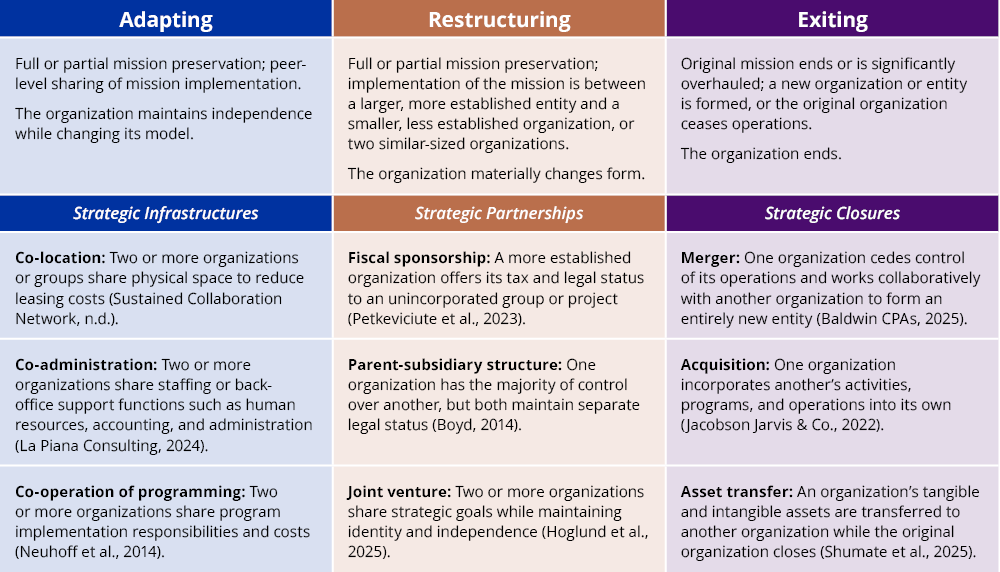
Click here to download a print-friendly PDF of the table.
Adapting: Strategic Infrastructures
The first category involves pursuing a strategic restructuring of programs, staffing, or the organization’s operational model. Actions in this category are appropriate when capacity problems are internal, and the operating environment remains viable. It is the ideal first option to consider when a nonprofit begins to struggle or sees signs of instability on the horizon.
When considering adaptation, an organization might study partnering with other organizations to explore co-locating offices or programmatic space, co-administering programs or operational functions, or co-operating particular programs or services.
The key to adapting is being open to changing your model and asking for help from peers and networks. Involving board members in this conversation early on can help ease the transition and open lines of communication as your organization considers opportunities.
As with all the options outlined in our Strategic Options for Nonprofits Facing Crisis framework, many organizations already use and thrive on these strategies. Some examples involve individual nonprofits teaming up for mutual benefit, such as the co-location announced in 2024 by First Foundation of West Virginia, West Virginia University, and Ascend WV (Coyne, 2024). Other examples include individual organizations that coordinate and provide collaborative infrastructure services to a larger number of nonprofit organizations, such as the National Back Office Cooperative in Illinois and the Foraker Group in Alaska. In all their forms, these examples serve as inspiration, as reference models, and as resources.
Restructuring: Strategic Partnerships
Sometimes, dedicating the necessary time and effort for successful adaptation is not feasible. The level of intervention needed to sustain your mission may require more resources, structures, and capacities than these pathways can provide. Restructuring through strategic partnerships is the next level of evolution and includes considering fiscal sponsorships, parent-subsidiary structures, and joint ventures. These arrangements often include more formal legal agreements and take longer to execute. However, they can help an organization preserve some or all of its mission while receiving support in the form of monetary, administrative, or other resources.
Restructuring through strategic partnerships might also be appropriate when the operating environment is shakier, such as when you know there is a need for the services you provide, but the long-term outlook for securing necessary resources is hazy. Finding synergy between your organization and another that does similar or closely related work can help both organizations maximize their effectiveness.
Fiscal sponsorships, in particular, have grown enormously in visibility and use over the past two decades (Williams & Akaakar, 2024). Research from Social Impact Commons in 2023 found that “three times as many sponsorship programs were created in the last 20 years as were created in the 40 years prior to 2000” (p. 4). The sector’s largest sponsors, such as Fractured Atlas, Tides Foundation, and Rockefeller Philanthropy Advisors, each host hundreds of projects, while many community foundations provide fiscal sponsorship for place-based groups.
Interestingly, parent-subsidiary structures have become a new frontier for sustaining media. The nonprofit Lenfest Institute for Journalism has operated the for-profit, public benefit corporation, The Philadelphia Inquirer, since 2016 (n.d.), and the for-profit Pittsburgh Post-Gazette was acquired by the nonprofit Venetoulis Institute for Local Journalism in May 2026 (Setty, 2026). As media outlets continue to seek sustainable business models, the ecosystem is likely to become even more structurally dynamic.
Exiting: Strategic Closures
The options identified under the exiting category are intended to allow the mission to transform or change hands while the organization itself, or a specific program or line of business, closes or is absorbed by another entity. Within this category, a mission could evolve, metamorphose, or end via a formal merger with one or more other organizations, an acquisition by another organization or network, or an asset transfer that involves only a partial closure for the original organization. When done well, the organization’s original mission can live on in different forms within a different entity.
Strategic closure may be most appropriate when the organization is facing multiple crises or inflection points, such as leadership transitions, property damage, or legal challenges. It may also be worth consideration when the organization serves a specific community that otherwise has difficulty accessing resources, such as those living in a constrained geography or members of a small, identity-based community. In these cases, the loss of even one service provider could be devastating to the community, so finding creative ways to transition services and assets before closure is key.
Many strong case studies exist for how organizations can maintain mission continuity while transforming their operations. For instance, in 2025, Idealist and VolunteerMatch announced a merger, driven by the realization of the synergy between their missions and a desire to scale their impact. In early 2026, Candid announced several internal shifts, including asset transfers: followers of Candid’s Philanthropy News Digest and users of its job and RFP boards have been redirected to The Chronicle of Philanthropy and Idealist (Daniels, 2026a). Gose (2025b) recently highlighted the growing popularity of “merger matchmakers” in the sector, which connect nonprofits with peers and funders seeking to merge.
“One area for further exploration is to better understand what and whether nonprofits can learn broadly from the growing movement for limited-life philanthropy on the funder side[.]”
One area for further exploration is to better understand what and whether nonprofits can learn broadly from the growing movement for limited-life philanthropy on the funder side (Dale, 2025), a movement explicitly designed to advance strategic exits done well. As one example, in early April 2026, Dr. Traci Lester detailed in Nonprofit Quarterly how the intentional and strategic dissolution of The Opportunity Agenda strengthened the sector (2026).
Applying these categories to any nonprofit’s specific circumstances requires a clear-eyed assessment of where an organization is on the continuum of community needs, mission fulfillment, and operational maturity. Weighing and implementing each option involves asking important questions about capacity, resources, operating environment, and legal structures. Ultimately, each category asks leaders to return to that central question: “What is the best way to continue advancing our mission?”
Critically, these are questions we as a field and as individual organizations need to consider at every point in our organizational lifecycles, not only in moments of crisis. Moving the sector towards a culture of structural innovation, adaptability across scenarios, and mission- and community-driven collaboration will require more holistic operational models and tools that can be used over the long term.
The second part of this series provides a new resource to advance that cultural shift.
Adams, A., Burleson, J., & Brayton, S. (2025, October 13). An urge to merge: Shaping M&A success among nonprofit entities. The Wall Street Journal. https://deloitte.wsj.com/cmo/an-urge-to-merge-shaping-m-a-success-among-nonprofit-entities-be5e5f1b
Baldwin CPAs. (2025). Nonprofit mergers in 2025: Costs, strategy & foundation support. https://www.baldwincpas.com/insights/nonprofit-mergers-in-2025-costs-strategy-foundation-support
Bauer, K., Brenner, E., & Martin, T. (2026, April 8). Grounded in purpose: What philanthropy can learn from psychology. Dorothy A. Johnson Center for Philanthropy at Grand Valley State University. https://johnsoncenter.org/blog/grounded-in-purpose-what-philanthropy-can-learn-from-psychology/
Beasley, S. (2025, October 20). Emergency funding takes on new urgency amid government shutdown. Chronicle of Philanthropy. https://www.philanthropy.com/news/emergency-funding-takes-on-new-urgency-amid-government-shutdown/
Berry, E. (2017, February 9). New campaign encourages nonprofit leaders to expand their impact through strategic partnerships. BoardSource. https://boardsource.org/wp-content/uploads/2017/02/Power-of-Possibility-Press-Release.pdf
Boyd, W. L. (2014, June 22). Mergers, acquisitions, and affiliations involving nonprofits: Not typical M&A transactions. American Bar Association. https://www.americanbar.org/groups/business_law/resources/business-law-today/2014-june/mergers-acquisitions-and-affiliations-involving-nonprofits/
Buteau, E., Smith Arrillaga, E., Grundhoefer, S., & Im, C. (2026). A sector in crisis: how U.S. nonprofits and foundations are responding to threats. Center for Effective Philanthropy. https://cep.org/wp-content/uploads/2026/01/CEP_A_Sector_in_Crisis_FNL.pdf
Coyne, C. (2024, September 12). First Foundation partners with WVU, Ascend WV for free office space in five WV cities and towns. West Virginia Watch. https://westvirginiawatch.com/2024/09/12/first-foundation-partners-with-wvu-ascend-wv-for-free-office-space-in-five-wv-cities-and-towns/
Dale, E. (2025, January 15). More foundations opt for planned lifespans and spend-down strategies. 11 trends in philanthropy for 2025. Dorothy A. Johnson Center for Philanthropy at Grand Valley State University. https://johnsoncenter.org/blog/more-foundations-opt-for-planned-lifespans-and-spend-down-strategies/
Daniels, A. (2026a, February 12). As AI advances, Candid cuts staff, bets its future on data. Chronicle of Philanthropy. https://www.philanthropy.com/news/candid-cuts-staff-bets-its-future-on-ai/
Daniels, A. (2026b, April 28). Some funders want nonprofits to merge. Chronicle of Philanthropy. https://www.philanthropy.com/news/some-funders-want-nonprofits-to-merge/
Delaney, T. & O’Leary, A. S. (2022, February 16). Rising interest in nonprofit dissolutions and mergers. National Council of Nonprofits. https://www.councilofnonprofits.org/articles/rising-interest-nonprofit-dissolutions-mergers
Gazley, B., & Guo, C. (2020). What do we know about nonprofit collaboration? A systematic review of the literature. Nonprofit Management and Leadership, 31(2), 211–232. https://doi.org/10.1002/nml.21433
George, C., & Stinebrickner-Kauffman, T. (2021, September 22). Nonprofit mergers and acquisitions: Not just an escape plan. Stanford Social Innovation Review. https://ssir.org/articles/entry/nonprofit_mergers_and_acquisitions_not_just_an_escape_plan
Gose, B. (2025a, September 9). Mergers have become a lifeline for nonprofits. Will foundations help cover the costs? Chronicle of Philanthropy. https://www.philanthropy.com/news/mergers-have-become-a-lifeline-for-nonprofits-will-foundations-help-cover-the-costs/
Gose, B. (2025b, October 14). Matchmakers help charities find merger partners. Chronicle of Philanthropy. https://www.philanthropy.com/news/matchmakers-help-charities-find-merger-partners/
Grundhoefer, S., Smith Arrillaga, E., & Buteau, E. (2026). State of nonprofits 2026: What funders need to know. Center for Effective Philanthropy. https://cep.org/wp-content/uploads/2026/05/CEP_State_of_Nonprofits_2026_FNL.pdf
Guggenheimer, E. M. (2012). Charting the course: Legal help for nonprofits in troubled times (Executive Summary). Lawyers Alliance for New York. https://lawyersalliance.org/userFiles/uploads/order_pdfs/Charting_ExecSummary.pdf
Harold, J. (2025). Recombination as rebirth. Stanford Social Innovation Review. https://doi.org/10.48558/V7B5-R815
Hashimoto, E. (2025, January 14). Idealist and VolunteerMatch announce merger. Idealist. https://www.idealist.org/en/about/idealist-and-volunteermatch-announce-merger
Hoglund, J., Pann, K., Bonds, J., Beaty, T., & Maranga, K. (2025). Strategic partnerships of nonprofit organizations: A comprehensive literature review. Journal of Applied Business and Economics, 27(1), 189–200. https://doi.org/10.33423/jabe.v27i1.7505
Jacobson Jarvis & Co. (2022). Considerations for mergers and acquisitions. https://jjco.com/2022/07/20/considerations-for-mergers-and-acquisitions/
La Piana, D. (2010, Spring). Merging wisely. Stanford Social Innovation Review, 8(2). https://doi.org/10.48558/PHVG-EH14
La Piana Consulting. (2024, March). The partnership matrix. https://sustainedcollab.org/wp-content/uploads/2024/03/NSI-La-Piana-Partnership-Matrix.pdf
Lester, T. (2026, April 2). How dissolving your nonprofit can strengthen the sector. Nonprofit Quarterly. https://nonprofitquarterly.org/how-dissolving-your-nonprofit-can-strengthen-the-sector/
McLeod Grant, H., Wilkinson, K., & Butts, M. (2020). Building capacity for sustained collaboration. Open Impact and SeaChange. https://sustainedcollab.org/wp-content/uploads/2024/03/Building-Capacity-For-Sustained-Collaboration3.pdf
Neuhoff, A., Smith Milway, K., Kiernan, R., & Grehan, J. (2014, December). Making sense of nonprofit collaborations. The Bridgespan Group and Lodestar Foundation. https://www.bridgespan.org/getmedia/f5d1a314-a277-4a5f-a13c-8483360fac25/MakingSenseOfNonprofitCollaborations_1.pdf
Petkeviciute, A., Sattely, J., & Squire, T. (2023, November). Fiscal sponsor field scan 2023. Social Impact Commons and National Network of Fiscal Sponsors. https://static1.squarespace.com/static/5e84b5eaa39e6c2b3f14571b/t/65b13f7fd746ae371dbc84e4/1706114968580/2023+Fiscal+Sponsor+Field+Scan+Report.pdf
Setty, R. (May 5, 2026). The Venetoulis Institute goes to Pittsburgh. Columbia Journalism Review. https://www.cjr.org/feature/venetoulis-institute-goes-pittsburgh-post-gazette-newsroom-staff-cut-downsize-union.php
Shumate, M., Kijewski, L., Piatt-Eckert, K., & Thompson, C. (2025). Programmatic asset transfers: A strategic tool for social impact. Stanford Social Innovation Review. https://ssir.org/articles/entry/programmatic-asset-transfers-strategic-tool-social-impact#
Social Impact Commons, & National Network of Fiscal Sponsors. (2023). Fiscal sponsor field scan 2023: Survey report. https://nonprofitfinancials.org/wp-content/uploads/2024/05/2023FiscalSponsorFieldScanReport.pdf
Stevens, S. K. (2001). Nonprofit lifecycles: Stage-based wisdom for nonprofit capacity (1st ed.). Stagewise Enterprises.
Sustained Collaboration Network. (n.d.). Home [Website]. Retrieved November 21, 2025, from https://sustainedcollab.org/
Williams, J., & Akaakar, A. (2024, July 24). Fiscal sponsorship: A growing trend in the nonprofit sector. Dorothy A. Johnson Center for Philanthropy at Grand Valley State University. https://johnsoncenter.org/blog/the-fiscal-sponsorship-model-a-growing-trend-in-the-nonprofit-sector/