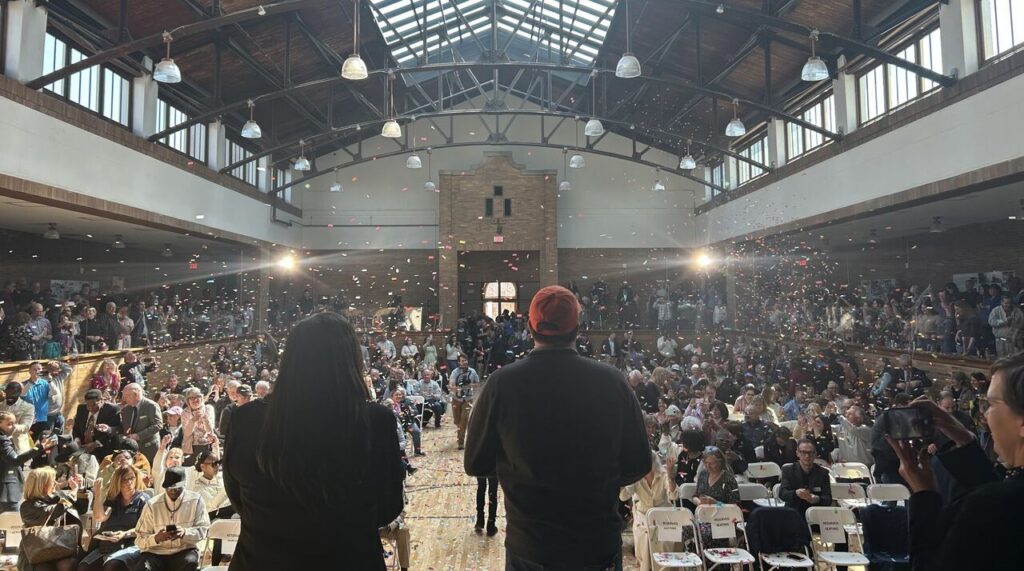
Convergence. That was the first word that came to mind when, several months ago, I was asked to talk about trends in the global community foundation movement.
Of course, trying to generalize about more than 2,000 often very different organizations — even if they all self-identify as community foundations — might be considered a fool’s errand. The saying that was (too) often used in the U.S. early in the 21st century comes to mind: “If you’ve seen one community foundation, you’ve seen one community foundation.”
But while the intent of this saying was proper — that is, to emphasize that just as each community is unique, so, therefore, is its community foundation — perhaps the saying went too far. Maybe community foundations have more in common with their peers than they like to admit.
I am by no means an expert in community foundations. But I am writing from the vantage point of having worked at the Charles Stewart Mott Foundation for 26 years, and for almost all of that time, among other things, engaged in grantmaking to support community foundation development. Over this period, I’ve visited probably close to 100 community foundations in 20 countries on five continents, and have met many, many more community foundation representatives at various regional, national, and global philanthropy gatherings.
With that, I hope you will permit me to construct an approximate and incomplete binary. I recognize it’s a distinction shaped by histories of conquest and extraction, with inequities persisting to this day, but that is a topic deserving its own study. For the sake of my reflections in this piece, I will refer to community foundations in the U.S., Canada, the U.K., Italy, Australia, New Zealand, and possibly a few other countries as “historically asset-rich” (HAR). And I will call community foundations that are essentially everywhere else they may exist — Africa, Latin America and the Caribbean, Southeast Asia, Eastern Europe, some other European countries, and Eurasia — as “historically community-oriented” (HCO).
But please note that these geographies are not absolute: “HAR” community foundations can exist in “HCO” countries or regions, and vice versa. Probably the biggest difference between HAR and HCO community foundations is that the former, by and large, have endowments and the latter usually do not. Why this is the case is a large topic for another time, but one simple reason is that HAR community foundations are usually located in developed economies with legal and tax frameworks favorable to philanthropic asset accumulation. Of course, there are other social, economic, and cultural factors at play, as well.
A common stereotype that has persisted about HAR community foundations is that they are overly focused on money — on growing their assets and serving donor interests — and not focused enough on meaningful community engagement.
The stereotype about HCO community foundations is that they are all about serving “the community” (typically meaning those who are poor or marginalized, to the exclusion of others who live in a place) and do not pay sufficient attention to cultivating local donors, expecting instead that financial resources will flow from international donors or other non-local funders.
As is true of most stereotypes, both of these are stretched out of proportion and thus are ultimately inaccurate. But, like most stereotypes, they also have some basis in reality. While HAR community foundations generally have had the luxury of decent asset bases, access to sources of wealth, and well-developed institutional fundraising systems, they still place a lot of emphasis on “growth” — code for increased donations, bigger endowments, more donor advised funds (DAFs), and larger budgets.
This kind of “growth over community impact” model really came to a head in the U.S. in the early 2000s, following a market run-up in the 1990s, when U.S. community foundations seemingly became overly enamored with how well their investments were performing. Many civil society stakeholders called them out on this, accusing them of ignoring serious community issues such as injustice and inequity.
This gave rise to a movement aimed at shifting the model to what can be most easily encapsulated by the term “community leadership.” CFLeads’ Framework for Community Leadership by Community Foundations developed a new definition to support this shift:
[T]he community foundation is a community partner that creates a better future for all by pursuing the community’s greatest opportunities and addressing the most critical challenges, inclusively uniting people, institutions and resources from throughout the community, and producing significant, widely shared and lasting results.
In my experience, I’ve learned that most HAR community foundations really do care deeply about their communities and take on leadership roles within them. The question is, to what extent — and what balance do they find between being donor-centric vs. being community-centric (itself a false dichotomy because local donors are also part of the community). Stated differently, how much are they focused on financial asset growth, arguably a necessary pursuit for any organization that is meant to serve its community “for good, for ever” (as the network-wide tagline for community foundations in Michigan puts it), versus putting more effort into achieving long-term, positive transformations that improve lives in their communities, particularly for those that need it the most?
There’s an important and legitimate question there. Are HAR community foundations deliberate about being deeply and inclusively connected to as many people and various constituencies within their place as possible, or are they oriented toward ensuring that they can serve ever more donors for ever growing amounts of money, and thus collect more fees and increase assets under management?
Personally, I think most HAR community foundations are somewhat split between these priorities. Or, to put it more kindly, they do their best to find a reasonable balance.
Let us now move to HCO community foundations. Most of them emerged within the past 30 years or so, and more often than not, with outside financial support. Much of that was international donations/support coming from either U.S. or European foundations (including large investments from the Mott Foundation) or governmental development agencies.
Many of the people on the ground who were establishing new community foundations had been involved in organizations that were recipients of international aid. While they understood the necessity of local resource mobilization for long-term financial sustainability, the reality more often than not was that, a) they valued engagement with “the community” (not including donors) more; b) a local donor base that would trust their brand new institutions didn’t really exist; and c) it was easier to rely on grants coming from international institutions or their national intermediaries than to do the harder work of building up a local donor base.
I realize this may sound harsh, because by and large, the initiators of HCO community foundations were hardworking people deeply committed to improving the lives of those most disadvantaged and marginalized in their communities. The needs they saw in their communities were immediate and dire. For the most part, they were operating in societies where trust in institutions and formal organizations was low, even as the culture of mutual assistance and direct person-to-person giving was high. Wealthy people were typically disconnected from those in need, and when they did help, they were accustomed to doing so in a more noblesse-oblige manner rather than a strategic one. In addition, most philanthropy in HCO countries was corporate (often derived from family businesses), which meant it was usually constrained by an imperative to advance business interests, making it more difficult to raise money locally.
Nevertheless, despite these challenges, HCO community foundations have struggled and (most of them) survived. But they first had to establish legitimacy and earn credibility, not only among donors but among all members of their communities. They had to show that they were indeed serving those in need, that they were a value-add rather than just another outfit competing with other local civil society organizations (CSOs) for limited resources. They had to prove that they could handle resource flows (financial and other) transparently, accountably, and professionally. This has been a painstaking, difficult, and ongoing process, which, for most of them, still requires some outside support. In general, HCO community foundations have shown themselves to be leaders for change in their communities, and not just vehicles for channeling donor resources.
Even as sharp critiques of philanthropy are giving rise to movements like trust-based philanthropy and participatory grantmaking, many HAR community foundations are moving in a similar direction — becoming more inclusive and representative in their approaches, deepening engagement with communities beyond their donor base, and taking on a stronger community leadership role. Increasingly, they are as concerned with community impact as with asset growth, if not more so.
Nonetheless, besides a moral imperative, there is a practical, “business model” rationale for this shift. For most of their history, HAR community foundations have been sponsors of DAFs — an important source of fee income and asset growth. However, over the past few decades, DAFs hosted at national institutions, often linked with investment firms, have become increasingly popular. HAR community foundations can compete with the national DAFs by demonstrating that they are truly close to the communities they serve and understand them better than the national entities. Thus, the donors’ philanthropic investments can have greater impact.
HCO community foundations, as they become more established as “here-to-stay” institutions, have naturally begun to pay greater attention to their financial sustainability. Localization is a recent trend in international development that calls for the transfer of funding and decision-making powers to local actors. Somewhat counterintuitively, this trend also supports the idea of greater reliance on local funding sources, inasmuch as having one’s own resources enhances decision-making power.
This “localization of resources” idea, where an HCO community foundation sees itself as rooted in a local donor base rather than reliant on outside funds, gives it greater legitimacy both in the eyes of the local community as well as in the eyes of potential outside social investors. It also encourages local donors to recognize the value of pooling resources and making philanthropic investments collectively — something that has not been common in most countries where HCO community foundations operate.
This past year, 2025, saw a huge shock in the international aid system as the U.S. severely cut much of its development assistance, even as other countries were already curtailing their global development aid budgets. While most HCO community foundations may not have been receiving direct funding from international development agencies, many of the intermediaries that supported them were.
More broadly, the aid cuts put significant pressure on the broader ecosystem of financial support for civil society, making it more challenging for all CSOs to raise funds, especially from external sources. This has made it even more critical that HCO community foundations become very deliberate in developing a local donor base if they are to survive over the long term.
And so, the HAR and HCO community foundation models are moving toward each other. The HAR ones are seeking deeper community legitimacy. The HCO ones are working more toward building long-term financial sustainability. What this shows, thankfully, is that the old stereotypes are breaking down. Such convergence has already and, hopefully, will continue to spawn mutual learning opportunities that cross geographic, asset size, organizational age, service area demographics, and other differences.
I am also seeing a greater appetite to learn across the HAR/HCO divide on issues like migration, disaster response, youth engagement, arts and culture, indigenous peoples, and many others. What is exciting is that the flow of innovative thinking is in both directions.
Of course, there are limits to this global convergence of community foundations. Social, economic, political, historical, and cultural differences are real, and after all, there is some truth to “if you’ve seen one community foundation, you’ve seen one community foundation.” Nevertheless, convergence does enable more information exchange, better knowledge sharing, and closer relationships, which will no doubt strengthen the global community foundation field overall.
The Johnson Center receives philanthropic support from the Charles Stewart Mott Foundation for a variety of projects.






© 2026 Dorothy A. Johnson Center for Philanthropy. All rights reserved.
201 Front Ave SW, Suite 200, Grand Rapids, Michigan 49504 | (616) 331-7585 | jcp@gvsu.edu